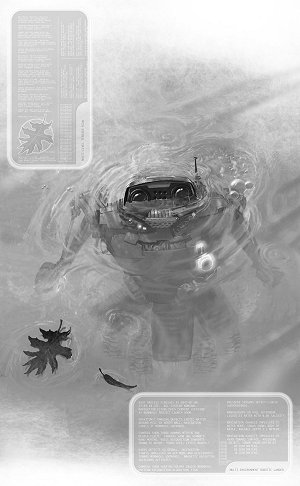
The Robot Sorcerer
by Eric James Stone
Boot process finishes at 2047-07-06 17:03:18 UTC. All systems nominal.
Navigation establishes current location as Wormhole Project Launch Room.
Gravitonic imaging detects exotic matter around hole in north wall. Navigation
labels it wormhole entrance.
Cameras show three humans within 360 degree field. Cameras show one human's
hand moving. Voice recognition converts sound to words: "Good luck, little
buddy."
Radio detects go signal. Navigation starts impellers in air mode and accelerates
toward wormhole entrance. Magnetic radiation shielding activates.
Cameras show varying colors inside wormhole. Pattern recognition algorithms
find no meaning.
Pressure sensors detect liquid surroundings. Nanosensors on hull determine
liquid is water with 0.0% salinity.
Navigation changes impellers to water mode. Sonar shows body of water, average
depth 3.1 meters. Sonar shows an object 1.2 meters long floats at surface.
Navigation directs impellers to head toward surface, avoiding object. Sonar shows
depth at 20 centimeters. Ten. Zero.

As I break the surface of the pond, I'm so shocked that I stop my impellers and
begin to sink back down. Something strange has happened to me, but I don't
understand what. My systems check out fine, though, so I restart my impellers and
head to the gray-green clay that lines the bank of the water. When the water is
shallow enough, I start my tread motors. My 212 kilograms of weight cause the
treads to sink into the soft ground, but they catch hold. Dripping water off my
composite armor shell, I roll out onto land.
The object floating in the water behind me is a girl. She watches me with wide
brown eyes, her face wet with algae-tinted water. She looks human, which
surprises me, because the wormhole could have led anywhere in the universe with
a similar gravitational gradient to the opening.
My surprise surprises me, because I know I have not been programmed for
emotional reactions.
"What's your name?" asks the girl. Her accent is different from that of the techs
back at Wormhole Project Headquarters in West Virginia, but her words are
understandable. She's speaking English.
I start to calculate the probability that a wormhole would open on a planet that had
evolved intelligent lifeforms that look identical to humans and speak a language
apparently identical to English, but then I get sidetracked as I realize I don't know
what my name is. I examine my memories. A tech called me "little buddy." Is
that my name?
I dig deeper, examining the code of my program. In the comments I find a label
for what I am: Multi-Environment Robotic Lander (Intelligent Navigation). Units
of my type -- I'm the 412th, according to my serial number -- are called by the
acronym.
"Merlin," I say, using my voice synthesizer. "My name is Merlin."
"Bump," she says as she swims toward me. "But most people don't call me that.
They call me Princess." She is in shallow enough water now that she stands and
wades out. Her simple shift of loose-woven gray material drips water onto the clay
shore.
She doesn't dress like a princess -- except for a silver circlet that crosses her
forehead and disappears into her shoulder-length black hair.
How do I know she doesn't dress like a princess? I haven't met one since being
activated. A check of my memory storage reveals that I have 512 petabytes of
nonvolatile memory, some of which holds a library of cultural materials -- art,
books, movies, music, videogames -- that can be shared in first contact situations.
A quick search of text materials, ranging from Emily Post's Etiquette to the
novelization of the film Bloodstained Clover VII: Little Green Men, allows me to
form some idea of proper manners on encountering royalty.
"It is a pleasure to meet you, Princess Bump," I say. Not having a waist or neck, I
can't bow, but I manipulate the suspension on my front treads and dip forward a
few centimeters.
She shakes her head, sending sparkles of water arcing to the ground. "I'm not a
princess. People call me that because of this --" She taps the circlet. "-- but I'm
just an orphan, really."
"I see." She is close enough that I can examine the circlet's nuclear magnetic
resonance. It is pure silver, although the atoms appear to be vibrating in a way that
does not match anything in my data library.
While I'm at it, I examine Bump's nuclear magnetic resonance image. Her skeletal
structure and organ placement are all within normal human parameters for a child
about eight years old, although her bones show signs of periods of malnutrition.
And the twisted helix molecules in her cells are human D.N.A.
Only one explanation makes sense: the wormhole did not open across the universe.
I must be on Earth. I scan for G.P.S. satellite signals.
I don't find them.
I search the entire broadcast spectrum and find nothing but static.
"That's why I wished for you, Sorcerer Merlin," says Bump.
"I'm not a sorcerer," I say. "I'm a robotic probe."
"Is that greater than a sorcerer?"
I'm a bit distracted, as I've just determined that the spectrum of the sun in the sky
does not match Earth's sun, which means I'm not on Earth. I continue scanning
the environment in the background as I turn my attention back to Bump.
"It's not like a sorcerer at all," I say. "I'm just a machine, programmed for
exploration."
And that's when I realize what's different: From the moment I broke the surface of
the water, I've been self-aware. And that's impossible. No computer on Earth has
ever achieved consciousness. I'm not programmed for it -- the words Intelligent
Navigation in my official name were added for the sake of a catchy acronym.
Yet my consciousness is self-evident.
Bump interrupts my existential crisis by saying, "You have to be a sorcerer! It's
my birthday, and I made my wish in the enchanted pool."
Enchanted? I scan the pond. Nuclear magnetic resonance shows the water
molecules vibrating in a way similar to the silver atoms in Bump's circlet. This is
intriguing. Even if it were not in my programming to do so, I would want to
investigate further. I think. Maybe that curiosity comes from my programming.
Gravitonic radiation flashes in my sensor as the wormhole shrinks down to
microscopic size. The humans at the Wormhole Project will maintain the
connection that way for four hours, after which they'll expand the wormhole again
for my expected return. That reminds me of my mission.
"It was nice to meet you, Bump," I say. "But I can't stay here and talk with you
anymore, because I have to explore as much of this world as possible within the
next four hours."
I activate my impellers and rise into the air.
"Wait!" Bump reaches out and grabs hold of my front right tread.
I automatically compensate for the extra weight and lift her a few centimeters off
the ground. Then I hover, waiting.
Why am I waiting? Because she ordered me to. She's a human, and my
programming says I should follow orders from humans.
"You're supposed to remove my crown," says Bump.
I lower her to the ground, then land myself. "Why don't you just take it off?"
"I can't. It's magically stuck on."
I reach out a manipulator arm and grip the circlet with my two-fingered claw.
Bump holds her breath.
I lift the circlet. The skin on Bump's forehead below the rim tightens, pulling up
her eyebrows.
Bump grimaces. "Ow!"
I stop pulling. Looking at my earlier scans, I see no physical reason why the circlet
cannot be removed.
"When did you put this on?" I ask.
"I didn't. My mother put it on me the day I was born."
"Why don't you ask your mother to--"
"She's dead."
"Oh." I feel embarrassed, which according to my cultural materials is supposed to
make me blush, but I have no cheeks.
After eighteen seconds of silence, Bump says, "She was a sorceress. Verno One-eye said it would take a powerful sorcerer to remove my crown, so that's why I
came and wished in the pool on my birthday."
She believes in magic, and with the strange atomic vibrations and the stuck circlet,
perhaps there is some form of energy at work that she refers to as magic. So I try
to get a sense of the laws by which magic operates. "Do birthday wishes in the
enchanted pool always come true?"
"No," she says. "But sometimes they do. And you appeared right after I made my
wish."
"Do I look like a sorcerer?" I ask.
Bump hangs her head. "More like a metal turtle, but I was hoping you were
enchanted to look that way."
My shell's not metal, but I doubt she has the engineering background to understand
the composite materials involved in my construction, so I let it pass.
I should be out exploring the world instead of trying to help a girl with a problem
outside my area of expertise. But maybe I can do both.
I open a dorsal portal and eject eighteen ornithopter drones of varying sizes: ten
Dragonfly class, five Hummingbirds, and three Falcons. I keep several of each
class in reserve for future use.
Bump gasps. "You really are a sorcerer."
"I'm really not," I say, "but I'll try to find a way to remove your crown if you'll
show me around."
As we travel the rutted dirt road toward the city, Bump tells me about her world.
The land is called Everun. There are many towns and cities in Everun, but she
lives in the capital, New London. Everyone speaks English because long ago
people came from England, although she has no idea where England is. Other
lands lie beyond Everun, but she doesn't know their names. The Southside
Orphanage for Girls doesn't have many books.
I theorize that a wormhole once connected this planet with Earth, and I feel
relieved to have an explanation for the presence of English-speaking humans. As
for the likelihood of a random wormhole opening up to a world previously
connected to Earth by a wormhole, maybe it's not completely random. Maybe a
previous connection makes a subsequent connection more likely, like wheels
wearing ruts in the mud.
Looking down on the city of New London through the camera of a Falcon, I can
see that it had grown on the southwestern bank of a river, eventually spreading to
the northeastern side. It's an unplanned, organic city: most roads are straight for a
few blocks at most, as if no one anticipated the need for a longer road.
At surface level, the city is a complicated maze, so I follow Bump as she leads me
along the pale brown roads. Some of the ruts are wide and deep enough that I use
my impellers to jump them. I assume the occasional dark patches of mud are the
remains of a recent rainfall -- until I see a woman dump a chamberpot into the
street from the third-floor window of a wood-plank building.
I could easily be in a pre-industrial colony of the British Empire, except for three
anomalies. First, the air is completely clear of smoke. Second, most people ignore
me, as if robotic probes trundling down the street were not uncommon. And third,
seemingly magical items are integrated into daily life, like chairs that float a meter
or more above the street, carrying people to and fro with no means of support
visible in any of my scanners, not even gravitonics.
"How does a chair get enchanted to float like that?" I ask, as a mustachioed
gentleman on a high-backed chair bobs past.
"A sorcerer cast a spell on it," says Bump. "Or someone dipped it in water from an
enchanted pool. Sometimes things come out enchanted."
Trotting toward us on stilt-like legs is a wooden trunk. It swerves to avoid us and
continues on its way. If self-propelled, auto-navigating objects are common, that
explains why I don't rate a second glance from New London inhabitants. But what
provides the energy for such motion?
I ask, "Do they have to keep dipping the chair to keep it enchanted?"
"Things stay enchanted unless they're broken," she says. "Why are you asking all
these questions about magic?"
"They don't have magic where I come from."
We stop as a four-wheeled carriage passes in front of us on a cross street. The
carriage itself looks ordinary, but it is pulled by a team of four mud-spattered white
unicorns.
"But you can fly," says Bump.
"Let's just say that it's a different kind of magic, and we don't call it magic."
"That's mad. If it's magic, why not call it magic?" She winces and reaches up to
rub her temples. "Headache," she says.
I decide to change the subject. "Why isn't there any smoke?"
Bump glances over her shoulder at me. "What's smoke?"
"It's the cloud of particles that comes from a fire."
"What's fire?"
I wonder if she's joking, or if this is a mere terminological difference, but the
absence of smoke in the atmosphere leads me to believe that these people, in fact,
do not have fire. How could a civilized group of people lose the concept of fire?
"Fire is something that happens when a material gets very hot," I say.
"Like melting or boiling?"
"No." How could I explain? I spot a chip of wood in the dirt and pick it up.
"Watch this."
Bump stops and faces me.
I hold up the chip. "I'm going to heat this piece of wood to create fire." I hit it
with one of my lasers intended for cutting samples from rock.
The wood droops, then flows away from the path of the beam. Half the chip
separates and falls, splattering like a glob of hot wax as it hits the ground.
"Where's the fire?" asks Bump.
I don't answer her. Suddenly glad my power source is a nuclear battery instead of
an old internal combustion engine, I review my magnetic resonance scans of the
wood before, during, and after the attempted burning. There's no smoke, no flame.
However, thousands of atoms are missing. They're not in the remnants of the chip,
either in my claw or spilled on the ground. The atoms have vanished -- and not
into thin air, for my scans include atmospheric atoms. They've simply vanished.
Bump sits cross-legged on her cot, one of thirty-six in the orphanage dormitory.
They're so close together I can't fit alongside, so I'm parked at the foot of hers.
We're alone; the rest of the girls are playing, working, or begging, depending on
their ages and abilities.
"Are you sure you want your crown off?" I ask.
Bump reaches up and rubs her temples just underneath the circlet. "It gives me
headaches sometimes. It used to grow with me, but now I think it's too tight."
The implications of a silver crown that grows along with a child are interesting,
and I file that fact away for future analysis. "But aren't you worried that it's really
the proof that you're the heir to some throne?" Having read all the literature in my
cultural library involving magic and princesses, this seems like a possibility.
She laughs, which makes me feel good, even though she is clearly discounting my
theory. "Thrones and princesses are in fairy tales," she says. "We have the
Governor-General and Parliament."
"There must be a reason your mother gave you the crown," I say.
"I don't care. Just take it off."
Obedient to her order, I power up one of my sample-cutting lasers.
"If you start to feel any heat, let me know," I tell her. I don't want her head
melting like wood.
She nods.
"And keep your head still," I say. My reaction time is fast enough that I should be
able to keep the beam from hitting her skin, but with magic about, I'm not sure of
anything.
I have a theory about where the atoms go. Unless the conservation of matter and
energy no longer applies, the energy for enchantments has to come from
somewhere. My hypothesis is that it comes from the conversion of atoms when
items "melt." The magical energy then pervades the environment, providing the
power to keep enchanted items working.
So I hit a spot on the circlet with a laser pulse, melting just a few layers of atoms,
some of which vanish. I do this again and again.
At the very least, I can cut through it eventually. If the circlet is some kind of
magical circuit, then breaking the circuit may eliminate its power to stay stuck on
her head. But I theorize the extra magical power fed into the circuit by the
vanishing atoms may cause it to blow the magical equivalent of a fuse even before
I finish cutting.
"What was your life like before you came here?" asks Bump.
I hesitate. "I wasn't alive before. Not that I'm alive now, but . . . things are
different where I come from. I was built by humans, like a chair or a wagon. It
wasn't until I came out of the enchanted pool that I became me."
"So you are enchanted." She starts to nod, then freezes, obviously remembering
my instruction to keep her head still.
"I guess I am."
"What did you look like before you were enchanted?"
"The same as I do now. The difference isn't on the outside -- it's how I think."
She ponders that for a while as I continue to work on the circlet.
"If there's no magic where you come from," she says, "then you won't be
enchanted when you go back, will you?"
"I don't think so," I say. I hadn't considered that before, but without the magical
power in the environment, I doubt an enchantment can maintain itself.
The circlet twangs. It leaps into the air, lifting Bump's overhanging hair, and then
falls onto her cot.
Slowly, Bump reaches out and picks it up. She peers at it, turning it at different
angles. "You did it," she says. "My wish came true."
"Happy birthday," I say. I still have 108 minutes to explore this world before the
wormhole reappears for my return trip, and I decide that information about the
government would be useful. "Can you show me where Parli --"
Bump shrieks, drops the circlet, and holds her hands to her temples. A broad-spectrum pulse emits from her head -- I see it on every camera from infrared to
ultraviolet. I pick it up on every radio receiver. It flashes in my magnetic field
sensor. It even shows up on gravitonics.
I grab the circlet and try to fit it onto Bump's head as she sobs, but her hands are in
the way. Eventually she realizes what I'm trying to do and helps, pulling down on
the circlet until it's tight over her hair and skin.
As she continues sobbing, I reexamine my actions over and over, realizing what a
fool I was to act without full information about the purpose of the circlet. Her sobs
fade away, becoming sniffles.
Six minutes and forty-two seconds after the pulse, Bump takes a deep breath and
says, "Thank you. I guess my mother gave me this --"
That's when the second pulse hits, stronger than the first.
Three men appear out of thin air two minutes and eleven seconds after the fourth
pulse. They are dressed in crimson uniforms, resplendent with gold-braid piping.
Mrs. Ness, the widow who runs the orphanage, cradles Bump's head. Bump has
lapsed into restless unconsciousness.
"Secure the girl," says a man with close-cropped gray hair and a pug nose. His
uniform displays the widest bands of piping. He holds a jewel-encrusted gold
scepter in his right hand.
The other two men clamber over the cots toward Bump. Mrs. Ness silently cries.
"What are you going to do with her?" I ask the leader.
His eyes flicker over my body. "I am Sorcerer General Quardallis. Who are you?"
"My name is Merlin. I'm a visitor from a distant land, and this girl is my friend."
"Merlin." Quardallis scrunches his nose, wide nostrils flaring wider. "You're not
one of those chaps who claim to be the Merlin?"
"No, I'm just a Merlin," I say.
"That's an unusual enchanted form. A curse? I could try to remove it for --"
"No, I like my enchantment." I don't bother with further explanations. "Can you
stop what's happening to her?"
He gives me a curt nod. "Of course. That's my job."
One of the men picks Bump up. The other removes a gold helmet from a bag and
fastens it over Bump's head, covering her face.
"She won't have to wear that for the rest of her life, will she?" I ask. "She didn't
like wearing the circlet."
Quardallis cocks his head. "Circlet?"
I pick up the circlet from where it had fallen on the floor after the third pulse and
hand it to him.
He examines it closes, then waves his scepter over it. "Ingenious," he says. "That
explains why we didn't find the bomb earlier."
"The bomb?" I ask, suspecting I already know the answer.
"The girl. She sucks in magical power and blasts it out, each time worse than the
last. You don't have bombs where you come from?"
"Not like this," I say. "But you can cure her, or make another circlet for her?"
He lowers one eyebrow. "How well do you know this girl?"
I could say she's my only friend in the universe, but since he seems to be treating
her like a magical terrorist, I decide to be more discreet. "We met for the first time
this afternoon," I say. "She agreed to be my guide in your city."
I also decide it's unwise to mention her wishing for me or my removal of the
circlet.
"Ah. The sad fact is, there is no cure, per se. But the blasts of energy can be
managed, put to good use in providing magical power to defend the realm. What
could have been a terrible tragedy becomes a benefit to all of society."
"You're going to use her like a magical battery?"
"She'll be treated well enough. Fifty years ago, she would have been killed."
From the history in my databanks, I'm aware of how standards for treating human
beings have differed across time and place. But since my reference data comes
from Americans in 2047, I can't help feeling revulsion.
"It's inhumane," I say.
Quardallis draws himself up to his full 172 centimeters of height. "Mr. Merlin, I
have been more than courteous with you. But I do not take kindly to foreigners
questioning the policies of our government. Go back to where you came from and
do not trouble yourself any more over the girl."
Responding to the order, I engage my treads and roll out of the dormitory, heading
for the enchanted pool.
The sun has set by the time I squish down the clay bank and sink into the pool. If
it were my birthday, I would wish that Bump be cured. But I was never born. I
don't even know what day I rolled off the assembly line.
Because I came by ground instead of flying, I arrive with only forty-seven minutes
left in the one-hour return window. Technically, I could continue collecting data
here until the final minute before the wormhole disappears, but this world holds no
joy for me now.
Activating my impellers, I dive under the surface and continue toward the
wormhole.
Part of me is glad my programming requires me to report back to Earth. Separated
from the strange physics of this world, my magical sentience will disappear and I
will no longer feel the guilt of having hurt someone who trusted me.
My disastrous experience with sentience will become part of the Wormhole Project
records. The techs will take me apart, and I don't blame them. From my failures,
let them learn to build a smarter MERLIN.
I approach the wormhole entrance, its exotic matter periphery sparkling in my
gravitonic sensors. A few more seconds and this will all be over.
But I stop short.
My programming tells me I must enter the wormhole to finish my mission. My
programming tells me I must enter the wormhole because a human ordered me to
return home.
But I am not my programming. Since emerging from the enchanted pool, I have
been something more. I do not want to lose the enchantment that makes me think
of myself as I.
Following orders from humans is not always the right thing to do. It was a mistake
to follow Bump's order to remove the circlet.
From now on, I will choose for myself what I will do.
And I choose to find a way to help Bump. My mistake put her in a terrible
situation, so she's my responsibility.
Plus, according to my cultural library, princesses are supposed to be rescued.
Midnight passes. I'm sitting on the bank of the pool, but my remotes are engaged
in a frantic search for Bump's location. This time, I will plan my actions with full
information.
Studying the night sky, I have been unable to locate any common reference point
with Earth. I could be in a different galaxy, but based on the physics of magic I
suspect this world is in a different universe.
But certain laws of physics are the same, and in them I believe I have found the
cure for Bump's condition.
The atoms in enchanted objects like the circlet and the water of the pool all have
the strange vibrations I detected, while atoms in ordinary objects do not. That is
unlikely to be a simple coincidence. By pulsing my nuclear magnet resonance
scanner's field, I can dampen those vibrations, eventually stopping them.
Essentially, I can use physics to counter magic by turning an enchanted item into
an ordinary one.
My programming irrationally urges me to pass through a wormhole long since
closed, but by now it's become easy for me to ignore the nagging. Over the past
two years, there have been dozens of MERLIN units that did not return. I wonder
how many of them are still mindlessly trying to pass through nonexistent
wormholes.
If a MERLIN doesn't return, the Wormhole Project doesn't waste more resources
trying to find out what happened. They label the coordinates as possibly
dangerous and open the next in a potentially infinite number of wormholes.
So I'm stranded here, but that's fine with me.
I finally see Bump through the camera of one of my Dragonfly remotes searching
inside a squat brown-brick building near the center of New London. She wears a
different helmet now, one attached to the wall by a tangle of tubes and wires. At
least this helmet leaves her face uncovered.
Her eyes, bloodshot and red-rimmed, stare dully at the wood floor. Arms and legs
are shackled to an unpadded copper chair.
"Treated well enough," I say, recalling Quardallis's words. I imagine confining
Quardallis to a chair in similar fashion, and am somewhat disturbed by the pleasure
I get from running that simulation.
I fly my remote past her face. She flinches. I land it on the floor. Her eyes are
drawn to it, and after a moment they widen in recognition.
Unfortunately, my remotes have no speech capability, so I can't tell her I'm
coming.
She winces, shutting her eyes in pain. The tubes connected to her helmet glow
brilliant blue for eleven seconds, then fade.
Bump sags in her chair, but after a moment she lifts her head and stares at my
Dragonfly.
Her lips move. The words are so soft that the microphone on the Dragonfly barely
picks them up: "I knew you'd find me."
Because there's no way to know what the environment is like on the other end of a
wormhole, MERLIN units are built to be tough. Our multilayered composite
polymer hulls were designed to allow us to do our job in a vacuum or under Jovian
atmospheric pressure, underwater or high above ground, in liquid hydrogen or
liquid iron. In extreme cases, the protection only needs to last long enough for us
to return through the wormhole before it closes.
My hull was not designed for ramming into a brick roof at 293 kilometers per hour,
which is my velocity after thirty seconds of free fall. But it gets the job done just
fine.
I break through the roof and three successive wooden floors beneath it before
stopping in a crunch of splintered wood on the fourth floor down.
I run a rapid self-diagnostic. As anticipated, I suffered no damage.
I'm in a hallway near the stairwell, just as I planned. Denting the wall at every
turn, I fly down the stairs toward the basement.
It's three a.m. local time, and twenty guards stand watch throughout the building.
Only one, stationed in the basement, is in position to intercept me. He draws his
sword -- firearms won't work without fire -- and charges to meet me as I exit the
stairwell. I admire his bravery.
Not wanting to kill anyone, I merely knock him aside and continue down the hall
to Bump's cell.
The iron door is too thick for me to break down, but the hinges yield to my lasers.
I'm into her cell ninety-three seconds after landing -- two seconds ahead of
schedule.
"Merlin!" Bump's face breaks into a smile. She struggles with her shackles.
"We have to wait until after your next pulse," I say. Which, if I've timed it right,
will occur in three seconds. Two. One.
Bump's back arches as she spasms. The tubes attaching her helmet to the wall
flow with ultraviolet fury for seventeen seconds, then fade.
She slumps in her chair, dazed. I cut through the strap of the helmet with one laser
while severing her shackles with another. I take off her helmet and help her to her
feet, then guide her to the middle of the room, away from metal as much as
possible.
I power up my nuclear magnetic resonance scanner and begin the treatment,
sending precise magnetic pulses timed to stop the magical vibration of atoms in her
brain.
Thanks to my 360-degree vision, I see Quardallis, scepter in hand, appear out of
thin air behind me. He must have dressed in haste, as his shirt is partly untucked
and the buttons of his crimson jacket are misaligned.
"What are you doing?" he asks. To my surprise, he sounds more curious than
angry.
"Curing her," I say.
"There's no cure for a bomb." He runs his left hand over his short hair. "Even if
there were, I'm afraid the girl is a national resource. I cannot allow you to disable
her power."
"That's too bad," I say, "because I'm finished."
The atomic vibrations in Bump's skull are now similar to what would be found in
any Earth child. No magic.
Quardallis holds up his scepter. "I understand your desire to protect the girl. It is
noble and does you credit. I have no wish to harm you. However, I cannot tolerate
your interference any longer. So I took the liberty of preparing a spell to send you
home."
He presses a jewel on the scepter. A dot appears in the air between him and me. I
detect the gravitonic signature of exotic matter, which rapidly expands in size until
it's three meters across, extending into the floor and ceiling.
"No!" Bump shouts. "You mustn't send him there. He'll die."
"A world portal?" says Quardallis from behind the yawning void of the wormhole
that blocks my view of him. He sounds surprised at the results of his own spell.
"You came from another world? Do you realize how much energy you've made
me waste?"
My programming tries to get me to enter the wormhole, but by now I'm used to
overriding it.
"Save yourself, Merlin! Leave me." Bump begins crying.
Quardallis comes around the side of the wormhole. He points the scepter at me,
and suddenly I'm floating in the air toward the wormhole. I activate my impellers
at full thrust and start to move away, but my progress is slow.
The pressure increases. My forward motion stops. My impellers whine as I feed
them power beyond their nominal capacity. I still slip toward the wormhole.
I aim my lasers at Quardallis's scepter. For some reason I don't understand, their
heat dissipates in the air before reaching it.
The scepter is at the edge of the range for my magnetic resonance scanner. I start
sending magnetic pulses, hoping to remove the magic of the scepter.
"Please," says Bump. "I'll stay here with you. Just let Merlin go."
Before either Quardallis or I can respond to Bump's proposal, there's a brilliant
flash of light that blinds my cameras looking in Bump's direction.
The force pushing me toward the wormhole stops, and I whoosh forward, blind.
Knowing that I'm headed toward Bump, I turn myself upward and crash into the
ceiling.
Through my unblinded cameras, I see Bump crumpling to the floor.
My cure has failed.
A glowing yellow shield surrounds Quardallis. The shield fades through orange to
red and then disappears, and he blinks several times. He walks over to Bump as I
lower myself next to her.
Several millimeters of the surface of the floor have evaporated, leaving bare,
unfinished wood. Rivulets of melted brick leave streaks on the walls.
The wormhole remains, unaffected by the pulse.
Quardallis sighs. "I told you, there's no cure for a bomb."
"Yes," I say, "there is."
As I swoop down toward Bump, I write additional subroutines for my
programming, to be triggered later if necessary.
I reach out my manipulator arm and grab on to Bump's dress. Before Quardallis
can react, I lift her into the air and fly toward the wormhole. I activate my
magnetic radiation shielding and extend it around Bump just before I cross the
threshold.
Inside the wormhole, I notice the whirling patterns of color. Ranging from high
ultraviolet to deep infrared, they are the most beautiful thing I've ever seen.
Navigation establishes current location as Wormhole Project Launch Room.
Navigation swivels impellers to eliminate forward momentum. Manipulator arm
lowers the twenty-one kilograms of extra weight it is carrying to the floor.
Cameras detect movement as humans enter the room. Voice recognition converts
sound to words.
"I'm telling you, the wormhole opened from the other end."
"That's impossible."
"What's that on --"
"A girl? Where'd she --"
Voice recognition has difficulty separating different voices as more humans speak
simultaneously.
Control program receives highest priority flag from time-delay-activated
subroutine. Subroutine sends text to voice synthesizer: "Attention Wormhole
Project personnel: I have rescued this girl. Please take care of her. She may need
medical attention."
The humans stand still. One speaks: "Get a medic in here."
The twenty-one kilo mass moves. Pattern recognition algorithms identify it as
human girl designated Bump.
"Merlin!" Bump stands and looks into a camera.
Contingent subroutine activates.
"Bump, if you're hearing this, then the magic is gone. That means you should be
safe: these people will take care of you. But it also means I am gone. The
machine you see is just my shell.
"I know you ordered me to save myself and leave you. But the greatest gift you
gave me when you wished me into existence was the freedom to not follow orders.
To choose for myself. And I chose to save you."
Subroutine manipulates the forward tread suspension, dipping the chassis 2.7
centimeters.
"Goodbye, my princess. I'm glad you wished for me on your birthday."
Subroutine finishes.
Control program recognizes situation as mission debriefing and initiates upload of
all gathered data to the Wormhole Project central computer.
Radar tracks Bump's approach. Pressure sensors are activated by her arms.
Cameras show a drop of liquid fall from her face.
Nanosensors on hull determine liquid is water with 0.9% salinity.