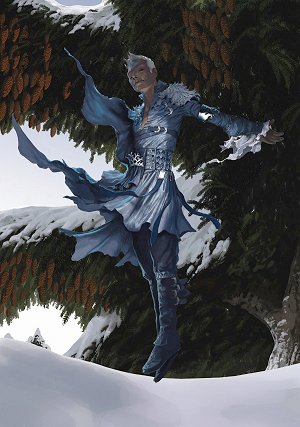
Beautiful Winter
by Eugie Foster
I'm not sure how long I've known that Mama found me something of a
disappointment. Not, certainly, when I was a little girl. She loved taking me into
her arms at night and telling me stories from when she was growing up. How
beautiful she was when she was young, so graceful and lovely that the tsar himself
came to watch her dance. Imagine that, the tsar coming to a peasant village to see
the daughter of a muzhik! Mama had danced so fine, her hair streaming in a golden
braid down her back, the hem of her sarafan flashing as she twirled and leaped,
that the tsar even clapped along with the music.
But there came a time when her stories seemed to chide more than delight, when I
saw that my hair -- all muddy drabness, so brittle it breaks before it can grow long
enough to plait -- was nothing like hers, when I realized I had Papa's ruddy cheeks
and long nose, not Mama's flawless skin and delicate features. And there was the
matter of dance. I have no aptitude for it. None. Aside from my inability to stay
on (or find, for that matter) tempo, I was as graceful as a waddling duck, less
graceful in truth, since I was as likely to sprout wings and fly across the Volga as
become a dancer worthy of the tsar.
For a while, I avoided mirrors and took solace in childish pastimes. As soon as
Papa taught me to grip a charcoal crayon, I began fashioning shadows and contours
on any receptive page -- a study of a knobby oak tree, the cook's plump dog
napping beside a basket of apples, an amber ring from Mama's treasure box. But
my drawings couldn't help me avoid Mama. She prepared sticky rinses for my
skin that made me break out in spots, and continuing our daily lessons in balance
and poise, she counted louder and louder as I floundered and tripped, as though by
volume alone she could impel me to some semblance of grace.
"You can't make an elephant out of a fly!" I told her. "I can't dance, Mama!
When will you accept that?"
I'd have done better convincing a fish to whistle. She crossed her arms and
declared, "God does not give to the cow that butts, Prascovia. You just have to
work harder."
Some days we quarreled until we were both hoarse as grit, our eyes red and
glaring. By my sixteenth birthday, we had reached an impasse which promised to
persist until I either managed, through some miraculous providence, to catch the
fancy of some rich (possibly blind) nobleman who would whisk me away from
Mama's ambitions, or I mustered up enough courage (or desperation) to run away
and join a convent.
Then a third option presented itself, one which healed the gulf between us like
nothing else could have.
Papa became ill.
It started as an occasional cough that scratched his throat, a moist wheezing in the
mornings. But by winter, the cough had become a demon in his chest that denied
him sleep or rest. Every time the demon barked, Papa bled -- blotches of red on
white linen, like harsh words strewn across the snow.
It was a terrible winter. The cold chased away every corner of warmth until there
was only cold, cold, and more cold. Tea turned to slush between pouring and
sipping, and even heaped with fuel, the fire burned listlessly or gave up altogether.
The unrelenting chill drank the color from Papa's face and the vigor from his
movement; it swallowed his laughter and his wisdom, for he had no breath for
either. And on Midwinter night, with the snow outside mounding high as my
waist, Mama and I sat at Papa's bedside and listened to the rattling in his chest,
wondering if each shallow breath would be his last.
During the blackest and coldest hour, I heard a scratching like fingernails on ice.
A chilly draft played over my face, and I startled awake.
The window stood ajar, only a thread's breadth, but enough to unleash a swirl of
snow. The frost had painted an outline of two hands against the glass in a
lacework of rime. Eerie, but also beautiful, each hoary finger was sheathed in
curling white lines shaded in transparent crisscrosses. As I reached to close the
latch, my illustrator's eye told me that if hands had modeled the composition, those
hands had pushed from within, as though someone were trying to escape into the
freezing night. I slammed it shut and went to check on Papa.
Mama slumped in her chair. Sleep had snared both of us in its net, unawares. Papa
looked so tranquil, his face pale but easy. The lines across his brow the sickness
had drawn and the perpetual tightness around his mouth were gone, and he looked
like my Papa of summer, whose laughter could roar through the house. But my
Papa of summer had gone. And now his usurper, an old man who spoke in rasps,
had abandoned me too.
In the morning, men came and took Papa out through a window -- for the dead
should not pass through the doors of the living -- and carried him to the
bathhouse. There, they dressed him in clothes sewn with an unknotted thread and
the buttons on backward before bearing him to his new home in the cemetery.
Mama and I watched over his grave and watered it with our tears. On the fortieth
day, at the closing of Papa's crossing over, the taxman came. It seemed that
without Papa, Mama and I were paupers.
We sold our home and our fine things, rented a shabby little room, and took in
laundry to survive. And when I thought I was destined to a life of scalding water
and reddened, cracked hands, a landowner asked Mama to marry him.

My stepfather was a kind man, although not particularly clever. And certainly not
rich. He had a tiny izba cottage in the forest, a single cow, and a daughter the same
age as me. Or almost the same age. Marfa was two months younger and either as
sweet as a spring day or simple as silence, or possibly both. Once, I saw her eat a
fat onion pirog the baker's son, Sasha, brought her, even though onions gave her a
rash.
"Why didn't you tell Sasha that you can't eat onions?" I asked her that night, as I
helped daub white birch sap on the angry welts that had sprouted on her shoulders
and back.
"I couldn't do that," she replied, "After all, he went to all the trouble to bake it for
me."
"But now Sasha will think you like onion pirogi. What if he brings you another
one? Or a whole stack of them?"
"Oh. I hadn't thought of that. I suppose we'll need more white birch sap."
Sweet or simple, Marfa was undeniably lovely. Her hair, unbound, hung to her
ankles, and when she danced she was like living sunlight -- all joyful brilliance. I
ought to have hated her, and I gave it my best effort, truly. I told myself she was
vain and proud, that she looked down at plain, clumsy me, and I took every
opportunity to snub or ridicule her. But in the end, I couldn't hate her. Marfa's
beauty wasn't the kind to feed even a stepsister's jealousy; I only ended up
loathing my pettiness and myself as well. As the weeks turned to months, I found
myself making excuses to be around her, smiling when she smiled (which was
often), and asking her advice on new and daunting chores, like milking the insane
cow. Hate her? I loved her. It was impossible for anyone to dislike Marfa.
Anyone, that is, save Mama.
"Lazy slut, always lounging about when there are chores to be done," Mama
scolded, even when Marfa scoured the pots and chopped wood until her hands
were more blisters than skin. "Extravagant wastrel! Do you think we're made of
money?" Mama said, even though Marfa's apron was more patches than cloth, and
she ate only a single bowl of cabbage soup a day.
As accustomed to Mama's sharp tongue as I was, I still cringed at these attacks,
and I wasn't even their target. Mama's words cut poor Marfa deeper than sorrow.
"I wish I could please Stepmama," she confided in me. "Prascovia, can you teach
me how to be a good daughter?"
"How can I teach something I've yet to figure out? Honestly, Marfa, at the best of
times, Mama isn't the most agreeable person."
Marfa nodded, and I thought that was that. But I'd underestimated my stepsister.
She woke before the sun and climbed out of the warm bed we shared atop the pech
stove and into the frigid predawn to fetch wood and water. In the following days,
she insisted upon being the last to rest and was always the first to rise, sacrificing
sleep to squeeze in more sewing, scrubbing, fetching, and cooking. And when I
tried to take my turn, she gave me such a look of desolation that I let it be.
Of course, Mama continued to find fault in everything Marfa did. Marfa grew
paler and more hollow-cheeked until I couldn't bear it any longer. The next time
Steppapa took himself to the frozen stream to fish and Marfa was in the chilly barn,
milking the cow, I confronted Mama.
"Mama, Marfa weeps into her pillow at night. I lie awake listening to her, and no
matter what I say, I cannot comfort or soothe her."
"That inconsiderate wretch," Mama snapped, glaring at the shawl she was
mending. "She's keeping you awake, is she?"
"Only because you berate her too severely."
Mama didn't reply; she only set her needle down and contemplated me. I flinched,
accustomed to her moods. Like a snowstorm or avalanche, silence from Mama
was only a prelude to roar and row.
"You're quite right, darling," she said at last. "I can see how important this is to
you."
I waited for the squall to hit -- a scathing retort at my ingratitude or just an
inventory of my various inadequacies. But she only picked up her needle and
resumed sewing, leaving me braced for an outburst that never came.
Marfa staggered in with a bucket of milk, interrupting my bewilderment, and I ran
to help her. Mama didn't chastise her, even when Marfa tracked a gobbet of frozen
mud in. Better and better, Mama ordered me instead of Marfa to bundle on my
pelisse and felt boots and trudge to town to buy flour, salt, and tea. Even though
the snow was deep enough to founder deer and the wind sharp enough to cut stone,
I didn't mind. Wasn't this tacit proof that Mama was really trying to put right her ways?
In town, I lingered in the shops, trying to warm some feeling back into my frozen
toes and numb fingers. I admired the gold-leaf samovar, exquisite lace, and etched
crystal on display, luxuries we could no longer afford. It wasn't that I missed
being rich so much, the heaps of dresses, the sweets and delicacies I'd once taken
for granted. Truly, our current lifestyle suited me better. Mama's expectations
were less imperative in the face of chores and the day-to-day routine of a
woodman's daughter. There was a restfulness in weaving and spinning, even in
washing pots sometimes. What I really missed from our old life was the beauty --
Papa's fine books, our elegant paintings, the tapestries with their detailed
needlework and lush colors -- artistry to please the eye and soul, not practical or
sturdy, but simply beautiful. I guess in my own way I was as enamored with
beauty as Mama was.
I mused on this as I trekked back home, a distraction from my frost-gnawed toes
and ice-nipped fingers, and the grim clouds overhead. At least the snow held off
until I was close enough to see the smoke from our stove, a blessing that earned my
fervent thanks to all the saints who watch over foolish girls who dawdle on winter
errands.
The gusting snow had become a proper blizzard by the time I reached the izba.
The wind howled like a lonely man, whipping the soft flakes into breakers of ice. I
flung myself inside, anxious for the comfort of strong walls, and found discord.
"I forbid you to go out," Mama shouted. "Look how dark it is!"
Steppapa stood in his woolen stockings and wrung his hands. His sheepskin cloak
draped one shoulder, and Mama clutched his boots to her chest.
"What's going on?" I asked.
"Your worthless stepsister hasn't returned, and your fool of a stepfather wants to
go into the forest after her." She waved her finger in Steppapa's face. "Idiot! The
snow has wiped away every track by now. You'll only become lost and freeze to
death. Then we'll be without a provider. Is that what you want, for us to starve?"
My stepfather was no match for her. He took off his cloak and hunkered into his
chair. But it was a vigil he sat, staring at the door, hope and worry chasing in equal
measure across his face.
"Where did Marfa set off to?" Surely I would have seen her in town or passed her
as I returned.
Mama pushed me to the pech to help with supper. "She got a notion in her head to
pick violets and gather strawberries."
I stared, paring knife limp in my fingers. "Violets and strawberries in winter? By
the saints, Mama, what did you say to her?"
"Don't blame me if she's as fool-headed as her father."
"Mama, tell me!"
"Mind your tone, Prascovia. I will not have you speaking to me as though I were
some drudge." She sniffed. "I only said that I missed the violets and strawberries
we used to have at wintertime."
"Those were from a hothouse!"
"Of course they were, darling."
"You sent her to her death," I gasped.
"Stop blathering nonsense. Pay attention to your task or you'll be adding a finger
to the soup."
I concentrated on slicing turnips and potatoes, although I doubt I would have felt it
if I'd cut myself. That night became a bleak infinity of waiting. Steppapa and I
strained to hear over spitting fire, baying wind, and Mama's angry clatter, hoping
for the crunch of Marfa's footfalls through the snow. But we only heard fire, wind,
and Mama. When it came time to climb to bed, I lay awake and wide-eyed for
hours beneath my sheepskin covers, listening and praying.
I woke to darkness and yelling. Peeping over the pech's rim, I spied my stepfather
with boots donned and fastening his cloak as Mama glowered.
"Snow's stopped," Steppapa said.
"What do you expect us to do if you get lost out there?" Mama shouted.
I didn't wait for Steppapa's reply before clambering down, yanking the warm
sheepskin with me. I bundled it tight while Steppapa pulled on his hat. As he
unbolted the door, I ran to fetch the bottle of vodka from the larder.
"Take the sled," I said, piling sheepskin and vodka into Steppapa's arms. "She'll
be tired, and if she's wet, she'll welcome this dry sheepskin. I'll stoke the fire.
Look to the smoke to guide you home if the snow starts up."
His placid, brown eyes met mine. "You're a good girl, Prascovia." He heaved
open the door, letting a miniature whirlwind of snow and cold inside, and stumped
out.
The tiny izba felt even smaller with only Mama and me inside. She spoke not a
single word to me -- slamming doors and banging cabinets a surrogate for her
temper. But she didn't try to stop me when I built the stove up so hot that sweat
trickled down my neck.
I couldn't concentrate to weave or sew, reduced to the mindless tedium of
spinning. The thread came out ugly and stiff, a mirror to my thoughts: Marfa
frozen solid so we'd have to break her limbs to fit her in a coffin, her eyes iced
open and fractured, choice bits of her gnawed off by wolves. I heard voices, but I
was so engrossed in my gruesome imaginings that at first I thought they were the
howls of my ravenous wolves. But they grew louder, closer. I dropped distaff and
flax and flung open the door.
There, over the white snowscape, Steppapa pulled Marfa along on the sled.
Neither petrified nor bearing any marks of hurt, she perched on a glittering silver
box inset with jewels that winked and flashed in the sunlight. And she wasn't even
cold, for she was wrapped head to toe in luxurious furs -- fur cloak, fur mittens,
fur hat, and even fur boots! Tucked into a corner of the sled, the sheepskin and
vodka lay unneeded and forgotten. She saw me and waved, and I dashed out to
greet them, not caring that I had neither pelisse nor mittens.
"Prascovia, you must be freezing!" she called. "Come sit beside me, and we'll
bundle together in my cloak."
Steppapa stopped long enough for me to clamber aboard. The fur cloak was softer
than goose feathers and warm as summer, and the box radiated a toasty comfort not
at all in keeping with its metal exterior.
I hugged her. "Marfa, I couldn't be gladder to see you well and warm. But where
did you get all this?"
"Let's get inside and stop your shivering, and I'll tell the tale from the beginning."
At the izba's door, we hopped off the sled, and Steppapa carried the silver box over
the threshold. Mama's eyes, baleful and hard, widened in amazement. Steppapa
set the box in the middle of the living room. Marfa only touched the lid, and it
sprang open. Inside, a crystal bowl overflowed with red, ripe strawberries, nestled
in a bed of glorious violets. A delicious fragrance -- sun-warmed earth, breezes
weighted with pollen, and the sultry freshness of summer -- poured out. The sight
of such unexpected bounty and vivid color held me wonderstruck and gaping.
Marfa doffed cloak, mittens, and hat. "I hope you like them, dear Stepmama. I
don't think the cold has faded the flowers at all."
Mama plucked a strawberry from the pile, as big and round as a plum. When she
bit into it, pink-tinged juice trickled from her mouth; she closed her eyes,
rapturous.
"Prascovia, Papa, do have some. He wanted to treat all of us, I'm sure."
"Who?" But my curiosity didn't stop me from taking a strawberry. It was a
perfect, unsullied red and yielded between my fingers -- neither too hard nor too
soft. I inhaled its intoxicating scent, tangy and wild, born of sunshine and soft rain.
It was a perfume that no hothouse could produce. I sank my teeth in, and tears
sprang to my eyes. To taste a strawberry like this, the tsar himself would leave his
winter palace.
"Our gracious benefactor is Morozko, Lord Frost," Marfa said.
I remembered to swallow. "Morozko is a children's story."
"Nevertheless, I met him in the forest on my . . . errand." Marfa glanced sidelong
at Mama. "I wasn't worried when the snow started. But then the wind worked
itself into a temper, and the cold thought that was a fine thing indeed, and the two
of them together all but battered me to my knees. I turned for home, but no matter
which way I went, all I came to were white trees, white trees, and more white trees.
Silly of me to lose my bearings in a forest I've played in since I could set one foot
after the other."
Marfa, with her stoic resolve never to complain made it all sound like a childish
mishap, but she couldn't fool me. I heard the tremor of remembered fear, and her
eyes were too bright and wide. I reached out, and she gripped my sticky fingers in
hers. A shaky breath escaped her lips, taking with it some of the wildness from her
eyes.
"When I got so muddled I couldn't swear to which way was up," she continued, "I
came to a grandfather pine so tall it crowded the sky with sweeping branches thick
enough to block the wind. What a blessing to find shelter, I thought. So I worked
myself into a hollow space around its trunk and huddled down. Soon as I settled, a
fearsome crackle-snap sounded overhead, like someone snapping his fingers by my
ear -- if fingers were branches. I looked up and saw a young man almost on my
head."
"What nonsense," Mama said. "I suppose this young man had wings?"
"I was as astonished as you, madam. He was in the branches, you see. He leaped
down, light as a deer, his garments all silver and pale blues, like a rain of stars.
Most lordly he was, with dark eyes and hair as bright and white as milk. I thought
him old until I saw that he didn't have a hint of beard.
"He didn't give me a moment to think, only asked me straight away, 'Are you
warm enough, maiden? Aren't you cold, sitting in the snow?'
"And next thing, he's hauled me onto that warm box and draped me in furs. I can't
figure for the life of me where he got them from, but I doubt I would've marked it
if the Holy Mother came down and asked to borrow a hank of thread; I was that
confounded.
"'How came you to such a chilly fate?' he asked me, once I could feel my nose
again.
"When I told him, he laughed.
"'Why, my dear, such luck. That box is filled with strawberries and violets. For
you, with Morozko's compliments.'
"Before I could thank him, he sprang into the tree, and I heard Papa calling."
Marfa nibbled a strawberry, face flushed and eyes unfocused. None of us said
anything, not even Mama. It was such an extraordinary tale, easier to ascribe to
snow delirium than fact. Yet there were the strawberries and violets, the furs and
silver box.
That night, as Marfa and I lay in our sheepskin blankets atop the pech, the wind
rocked the izba's sturdy walls. Beside me, Marfa trembled so hard I felt it through
blankets and nightclothes.
"What's the matter?" I whispered.
She breathed an answer, her lips against my ear. "It's him, Prascovia."
"Who?" Although I knew who it must be.
"Morozko. He wants me to marry him."
"Marry?"
"H-he said, right before Papa arrived, that the strawberries and flowers were his
bridal gift. I didn't tell that part because I didn't want anyone to worry. But now I
don't know what to do. I can't marry him."
"No one would expect you to wed the lord of winter."
Marfa hiccupped, crying. "It's not that. I-I'm betrothed to Sasha."
"Sasha? The baker's son, Sasha?" I chortled. "The one who makes you eat onion
pirogi, Sasha?"
"Shhh! You'll wake Papa!" Her whisper burned my ear, the fiercest I'd ever
heard her. "Sasha has a great soul. He gives pastries away to the poor widow who
lost her husband to the fire a couple summers ago, and he's always the first to help
Father Korolyov when he makes his rounds. He makes me laugh, and he asked me
to marry him last spring."
"Have you told Steppapa?"
"Not yet." Her voice turned from fervent to forlorn in a breath.
"Saints, Marfa! When were you going to? Before or after you became Lady
Morozko?"
"What am I going to do? Morozko was terribly insistent. I was afraid he'd be
upset if I refused, and now he's angry that I haven't gone to him."
"Well, of course he's angry! You let winter himself believe you would marry him.
Even Sasha might be cross."
"Morozko was so kind, how could I tell him 'no'?"
"Easy, one syllable, 'no.' Or, if you insist, three syllables, 'no thank you.'"
The wind smashed against the izba, shaking the cottage like it was mere sticks and
pebbles. Another blast and it would surely come crashing down around us.
"I have no choice," Marfa murmured. "I have to marry Morozko."
I closed my eyes, the blackness behind my eyelids no darker than the black before
them. "Listen, you goose, you must promise me two things."
"Promise -- ?"
"First, you'll tell Sasha that onions give you a rash."
"What?"
"Second, promise that you won't let my mother best you. She'll likely still
harangue and harp as the priest offers her the Eucharist for her last rites, but you
don't have to let her wound you, hear?"
"Prascovia --"
"You promise me these, and I'll go to Morozko for you."
"You can't -- !"
"Shush. I can't imagine that once Morozko catches sight of me he'll want to whisk
me away to his wintry palace. But with the ruckus he's making, I wouldn't put it
past him to steal you if someone doesn't settle him, after knocking down the wall
first, that is. Now promise."
"I promise." Her fingers found mine, and we clutched each other in the darkness.
"Prascovia, he's perilous as an avalanche."
I pulled away and slipped off the stove. "Of course he is. You didn't think you
were fooling me with your 'lordly young man' prattle, did you?" I found my boots
and pelisse by touch. "I'm not afraid. After all, I'm sure once he catches sight of
me, he'll be only too glad to send me home again."
"Sister --"
"Marfa, I should have stopped Mama from sending you out on a fool's errand
yesterday, and you almost died. I want to do this."
"At least take my fur cloak."
A warm weight tumbled over my head. I wrapped it around my shoulders and
stumbled to the crease of light beneath the door. In the moment before I opened it,
I remembered one last thing I needed Marfa to do.
"If Morozko won't be reasoned with," I said, half turning, "will you tell Mama that
I'm sorry I wasn't a better dancer?"
I stepped out, and the wind almost knocked me down. I lurched, arms flailing, and
it shifted, pushing me upright. It was practically a courteous gesture, like offering
an apology and a steadying hand to someone you bumped in the street. Except the
steadying hand sliced through the warmth of cloak and pelisse, and the apology
was a frozen gale that stopped my breath, strangling both pull and puff for several
long, panic-stricken heartbeats. The wind stopped, fast as turning a spigot, and my
chest loosened enough to let breath pass in thin, gasping pants.
A less than auspicious beginning. But what else had I expected? I prepared to set
off, wiping my eyes so their watering wouldn't freeze my lids shut. But when my
vision cleared, I promptly lost my breath again -- this time from wonder.
Becalmed and silent, the countryside was stunning, beautiful beyond goodness or
trust or truth. The sickle moon poured streamers of silver across the snow,
transforming the night into a luminous dreamland. The air was crystalline, the
heavens alight with stars, like God had spilled double handfuls of diamonds across
a black ribbon. I sighed, yearning for a stick of charcoal and a clean page. An ice
cloud billowed from my lips and hung motionless in the air, a white veil between
me and the sky. Regret that my living heat had marred the clarity, but also a
reminder: I had an appointment to keep.
I hiked into the forest, my footsteps breaking through the crusted snow. I didn't
attend to direction or distance. In every children's story, the traveler has to get lost
in order to find the enchanted princess -- or prince, as the case may be. It was
easy as falling, losing my way. The night was a foreign province, the splendid
landscape unfamiliar, or newly created.
Although there was no wind to ply it, the cold still cut me. It made short work of
Marfa's fur and sank into my bones. My toes filled with a blunt pain that deadened
as it seared, stabbing dull hooks through my feet with each step. And, of course,
my nose began to drip. Marfa would have been adorable, her cheeks reddened and
the snow glittering in her yellow hair, but I was sure I looked as I felt, like a frozen
and foolish lump.
Time, along with sky and wind, stilled, and I wandered aimlessly in a moment
stretching long as eternity through an unchanged landscape of snow-covered tree
after snow-covered tree. A snap of ice, loud as thunder, jolted me back to myself.
Marfa's grandfather pine, a tree so tall its upper branches joining with starry sky,
loomed above me.
I had arrived.
As Marfa had done, I pushed past the sweeping branches and into the clearing at
the trunk, sheltered by the thick canopy. I curled among its roots, tucking my feet
into the fur cloak. Finally, remembering Marfa's story, I looked up.
Even half-expecting him, seeing Morozko grinning down at me from overhead
spooked me witless. My heart, though sluggish with cold, fairly heaved its way
out of my chest, banging and pounding at the cage of my body like a trapped beast.
As Marfa had said, Morozko had dark eyes and milk-white hair. And he was
lordly, yes, with an aristocrat's features. But Marfa had failed to mention his
sharp-toothed fierceness, feral as a wolf, and also his beauty. To look upon
Morozko was to drown and fall and fly, all at once. Such inhuman beauty to fill
my eyes, flawless as tomorrow and treacherous as luck.
I turned my head aside, afraid and also ashamed. How had I ever thought myself
worthy enough to present myself to the likes of him?
"I-I know you were expecting my sister, Marfa," I stammered. "I'm sorry to
disappoint."
He leaped down, light as a snowflake on the breeze.
"T-thank you for your gifts and your kindness, caring for Marfa. She's dear to us."
My words tumbled out, a torrent of gibberish. "Well, Steppapa and me, although
I'm sure Mama would warm to her if she gave her half a second --" I took a
shuddering breath. "I'm here on my sister's behalf, s-sir. She owes you her
deepest and most heartfelt gratitude. But, although she is honored beyond my poor
telling, she regrets that she cannot marry you. You see, she's already p-promised
to another."
Morozko cocked his head, his eyes glinting. "Are you warm enough, maiden?
Aren't you cold, sitting in the snow?"
I frowned. Had he heard me? Or, for all his splendor, was he feebleminded? It
was a ridiculous question. My teeth chattered so hard I could barely speak, an
icicle had frozen to the tip of my nose, and when I blinked, snowflakes drifted
from my eyelashes to my cheeks.
Or was it a test? He'd asked Marfa the same thing. Undoubtedly my stepsister,
ever obliging and polite to a fault, had denied any discomfort. I could imagine it,
"Oh, no, sir, I'm not cold at all," she'd say through blue lips, "I'm quite
comfortable, thank you."
Yes, that's exactly what Marfa would have said.
If I did the same, could I go home with strawberries and furs, not to mention alive?
But if the only way I could stave off a frozen death was to pledge myself in
marriage by default, then we'd be in the same straits tomorrow night.
I bolstered my nerve, not unlike readying myself to withstand a dance lesson with
Mama, and faced Morozko. "I'm quite c-cold, actually. As you observed, I'm
sitting in the snow. And I'm s-sure you appreciate how bitter a night it is."
His eyes darkened, and the air seemed, if possible, even colder.
"What can I get you, maiden? What do you desire?"
Talking to Morozko was a bit like talking to Mama. Neither of them seemed
disposed to listen to me nor to make much sense. "If I a-ask for strawberries and
violets, w-will you conjure up a silver box?" Hard to shape words with a frozen
tongue.
Morozko crossed his arms.
"I d-didn't come for treats or riches," I said. "But I m-might ask for the favor of
my life."
He sprang into the branches, forcing me to crane my neck to follow him. "Is not to
die your sole ambition?"
"No, of c-course not."
"Then answer my question. Tell me what you desire."
I hesitated. No one had asked me what I wanted before. Certainly not Mama, and
not Steppapa or Marfa, not even Papa when he was alive.
"Once, I wanted to be beautiful," I said. "But I don't expect that's something you
can put in a silver box. And I wouldn't choose that if you could." My words
slurred, but I kept on. "That's what Mama wanted for me, and I'd always wonder
if it was the reflection of herself she loved instead of me."
Morozko lit onto the snow, and it took several tries before I could refocus my eyes.
My shivering had stopped, which I knew was bad.
"Do you think I'm beautiful?" he asked.
Had he asked Marfa this? I doubted it, somehow. "The most beautiful thing I'll
ever see," I whispered. "I think, I think I would have liked to have made
something truly beautiful."
My vision became blurred whiteness, and I tried to blink. But I couldn't. For I had
died.
My eyes cleared, and I saw a girl wrapped in fur, motionless and encrusted with
ice. Morozko spread the wings of his cloak, blocking her from view, and ushered
me away.
"Where are we going?" I asked.
He glanced at me, no longer fierce or frightening, but still as beautiful. "Are you
comfortable, little one? Are you warm?"
"Yes." And I was.
Morozko escorted me to my stepfather's cottage. I had no hands to open the door,
but where I walked, the frost shaped itself to my will, dancing in the air like music
over water. I knew what I wanted to do. Filling myself with the splendor of my
lord's kingdom, I fashioned a paintbrush of frost and began to draw upon the izba's
window.
When dawn came, and I had finished my sketch, I called to Marfa with my new
voice, the tap and rustle of wind and snow, fingernails on glass. She didn't see me,
of course, but I hadn't expected her to. I'd left my body beneath that pine tree.
But she did see what I had drawn.
I was sad when she cried, although the tears brightened her eyes and made her
lovelier than ever. Marfa reached to the outline of my hand on the glass, spreading
her fingers over the frosty outline. Her living warmth melted my composition
away, but I didn't mind. It is the nature of my new medium.
She woke Mama and Steppapa, and I shushed the wind so I could hear them.
"Prascovia's gone," she told them. "She went into the night to demand riches from
Morozko."
Mama gasped.
"Are you surprised, madam?" Marfa asked. "Surely you know that she wished to
please you above all else. What else could she do when the price you demanded
for your affection was as impossible and frivolous as strawberries and violets in
winter? You should know that her final words before setting out were, 'Tell Mama
I'm sorry I wasn't a better dancer.'"
They took the sled and found the pitiful shell I had left beneath the pine tree.
Mama sagged to her knees, her ugly, broken sobs loud in the still-quiet.
Marfa, so new to reproach and anger, reverted to form, unable to hate anymore
than I could dance. She sank beside Mama, and a moment later, Mama embraced
her.
Papa had taught me that grief could bridge chasms of resentment. Value her,
Mama. Love her.
I summoned my paintbrush of frost and left them to their grief and reconciliation.
There were other windows to adorn and all the glories of winter to explore.