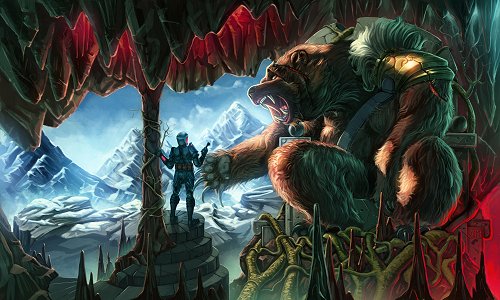
Inside the Mind of the Bear
by Rahul Kanakia
One cannot study creatures without being drawn to the strange example of the bear. In purely
numerical terms, the conflict with the bear was one of the costliest and most protracted creature-related wars. But the bear also left us another equally costly legacy: the myth of peaceful
compromise. Perhaps nothing has so damaged American creature-response protocols as the final
interview given by the bear. Reading about the bear's so-called "last plea for mercy" has led
generations of intellectuals to greet the emergence of each new creature with renewed calls for
appeasement.
Thankfully, the public has been steadfast in its resistance to bear revisionism. The popular
conception of the bear stems not from its words, but from images that were prevalent during the
height of its last rampage, when the bear crushed tanks and lay waste to city blocks. By then it
had grown to almost fifty feet. Its belly and forelimbs were matted with the dried blood of those
that had crossed its path. Along its back, it was singed to the skin by thermonuclear fire. It was
often photographed tearing ten-story buildings out of the earth or leaping up to pull helicopters
out of the sky.
The Second Law of Teratology states, "Peaceful coexistence is not possible between creatures of
greatly varying physical or mental abilities," and images like these seem to viscerally support
that law. For this reason, many of us teratologists are reluctant to delve into the bear's last
words, for fear of providing ammunition to those who would seek to ameliorate the savagery of
its crimes. But, in doing so, we have only allowed revisionist cranks to make unchallenged
claims.
Whereas, if we have the courage to examine the historical record, then we find that many of the
claims by apologists represent gross distortions of the bear's history and words.
For instance, bear apologists never cease to remind us that by the time the popular images were
taken, humanity had been attempting to kill the bear for more than a decade. And it is true that
three winters before it first left the forest, the bear was shot by a duly licensed hunter. The
apologists claim that this injury is what created the bear: there is something attractive to them in
the notion of this implacable enemy being birthed from a random act of human cruelty.
However, in their zeal to demonize humanity, these bear apologists have ignored the bear's own
words. We know from the bear's final interview that, to the bear, this injury was neither severe
nor especially remarkable. It was simply another one of the sudden obstacles that the bear had
faced over the years. The bullet wound was neither worse nor more surprising than the pain the
bear had carried in its jaw for the previous three years from a broken tooth: an injury which was
repaired by a sympathetic veterinarian shortly after the bear first left the forest. Thus, with just a
little research, we teratologists are now armored against the easy -- and, for many people, very
satisfying -- answer that the bear acted from some simple revenge motive.
In fact, during its last interview, the bear claimed that it was offered the opportunity to kill the
hunter who wounded it. The bear said it was given the hunter's name and location by a rogue
park ranger who sympathized with the bear, and had promised his superiors that he could
convince the bear to retreat with a minimum of destruction. But the bear refused to act on this
information, and murdered the park ranger because the bear was (in its own words) "disgusted
that a member of the human tribe could so readily abrogate his sworn duty to protect mankind
from the vagaries of nature."

This point has been belabored by a number of bear apologists, so I will repeat it only briefly: the
bear did not initiate the conflict against it. However, this does not nullify the hypotheses of the
teratologist. It strengthens them. We too believe that the bear was drawn irresistibly into conflict
with mankind because of its heightened abilities.
It is not clear how or why these abilities manifested. All that is known is that sometime after it
was wounded by that hunting rifle, the bear began to meet with quite a different response to its
normal foraging. Now, when the bear pawed at a car, the skin of that car was torn open like it
was made of cloth. Now, when park rangers arrived to shoo the bear back into more isolated
territories, the bear shrugged off their darts, reared up, slowly approached them -- as they
continued firing -- and finally took several swipes at them, leading to five deaths in three
incidents.
The bear noted in its final interview, "I could not quite believe what was happening. I wondered,
at first, if I was not perhaps mistaken in my perception of the depth and range of my own
powers. How could these intelligent and skilled men fail to understand that there was no way
they could withstand me? That nothing in their arsenal could stop me? That they had no choice
but to cede to me all that I desired? It seemed that my worldview clashed in some essential way
with theirs."
So we can see that, prior to its development of superursine abilities, the bear had been shot at in
the course of its daily existence. After it developed these abilities, it continued to be shot at in
the course of its daily existence. The only thing that changed was mankind's confidence in its
ability to kill the bear. This uncertainty soon resulted in the deployment of military force against
the creature.
However, from this foundation, bear apologists have proceeded to build up a picture of the bear
as a naïve, persecuted forest creature who desired nothing more than to be left in peace by
mankind.
In doing so, they have shamelessly taken advantage of the shocking, unwatchable nature of the
bear's first (and for many years, only) interview in order to make a plethora of false claims
regarding the bear's amenability to compromise. To this day, I am routinely dismayed to learn
that some eminent teratologist -- a man who has devoted his life to the study of creatures -- is
too squeamish to watch the following documentary footage and has contented himself with
summaries produced by biased hands.
I myself have watched the footage in full, and even a cursory viewing ought to be more than
enough to put another set of myths to rest.
The video opens with the documentary crew approaching the bear in a liquor store on the
outskirts of Gatlinburg, Tennessee as the bear is snapping off the neck of a bottle of rum.
"Don't you understand," says the documentarian, "That the National Guard won't stop attacking
you as long as you continue this rampage through our streets? You can't begin to fathom the
kinds of weapons that can be leveled against you."
The bear drains the bottle in a half-gallon sip. Then it rocks back on its haunches, and turns
towards the camera.
"I am well aware," the bear says. "That many men would prefer it if I remained in the forest and
did not wander the streets of man's towns and cities. But I am by no means sanguine that these
assaults would end if I returned to the forest. After all, it is in the forest that they began."
"But we didn't know, then, that you were intelligent," the documentarian says. "Surely some sort
of compromise can be made? You can be given land to live on."
"But who will give it?" the bear says. "Will a government official come here and sign a contract
with me? And what would be the terms of this allotment? Would I be left alone on my land?
Given my reading of history, this seems doubtful . . ."
"But we could work with you," says the documentarian. "I'm part of a coalition of groups that is
working to create a safe habitat for you."
"No," says the bear. "I have given this much more thought than you have, I think. When you,
after a long day of divvying up my future years, go home to your family, that is when I lay
sleepless by the side of streams, listening for the whine of planes come to kill me, and try to
imagine a future in which I can continue to exist. I believe that the only mutually acceptable
compromise would be for me to be granted some sum of money and the right to spend it as I
pleased. I believe that ten billion dollars would suffice. I could purchase a large amount of
terrain in my native range in eastern Tennessee. I could also employ a number of human agents
to oversee my holdings and investments. I would be able to fence off my land, and administer it
as best I am able, and live in isolation, much as any wealthy human recluse would."
"But . . ." the documentarian says. "But . . . that's perfect. All you want is full personhood? Well,
it might take a special act of Congress . . . but in order to stop the destruction you're wreaking, it
seems like a small price to pay . . . and considering your eloquence, you clearly deserve that title
on the basis of any sort of sapience threshold, why, I mean, you're quite articulate. More
articulate than me, I think --"
The bear turns away from the camera. It starts to paw through the shelves of the market.
"But, well," says the documentarian. "This is very doable. Just come with me. You can work
with our lobbyists. And as for the money, well, your blood alone, I mean the patents that are
going to come out of your unique DNA . . . those are going to be worth tens of billions. Even
television rights, or interview rights, or book rights . . . all that by itself would be enough to get
you started on your own range right away. Why don't you --"
At this point the documentarian's hand is on the bear's elbow, and he seems to be tugging on the
fur slightly. Then the bear simply . . . shrugs . . . and the camera falls to the ground. When the
image settles, the documentarian is lying on the floor and screaming. Blood pours from his face.
"Yes," says the bear, now off-camera. "I have thought quite a bit about doing this. But it would
necessitate me giving so many of these interviews. I would be jostled by so many cameras. I
would have to talk to so many men. And not just talk with them, I would have to negotiate with
them." The screaming is dying down, and the bear raises its voice to speak over the man. "I
would have to crouch in some man's office and know that I needed some concession from him in
order to continue waging the long -- years long -- legal battle to which you'd so blithely
commit me . . . and I would know that I could tear that man's throat out with a swipe of my paw
and he would know it too, but he would still smile at me and refuse me with polite words and I
would still have to slink away with my paws unbloodied."
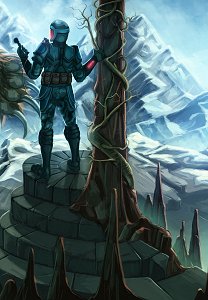
By this point in the tape, the screaming has quieted. The bear continues, in a softer tone. "That
would be the compromise. I would renounce violence. In return, you would give me access to the
nonviolent means of conflict-resolution your kind has carefully built up to deal with each other,
as well as the money that seems to be required to efficiently navigate those alternate dispute-resolution mechanisms. I do not think I will be given better terms than this, so maybe someday I
will take this sort of deal, but it still galls me. Even under this compromise, I would be nothing
more than a furry man. I would be constrained to speak in your language, and to adopt your
ways. I would have to deal with thousands of you, just to allow me to hunt and fish as I always
have. Under this compromise, you would have won everything! You would have neutered me!
And I would have sold my entire birthright to you for just the continued chance to exist. Yes, I
am talking about my birthright. I was born into a world where I was free to run where I pleased
and kill what I pleased and take what I pleased . . . until I couldn't . . . until something managed
to kill me. And I never gave up that world!"
Sirens and jets roar in the background. "I wish it were possible to make a better compromise,"
the bear says. "I wish that mankind could make the same compromise that the fish make . . . that
I will roam amongst them and take what I want . . . but that there will be few of me, and many of
them. However, I think that is not possible. I think the compromise that you and I have
hammered out here would be difficult to sell. It would require years of effort."
Here the bear grapples with the camera and points it towards its face. The bear lets out a roar,
and says, "But those are the years of my life! Those are the years of my strength and my virility!
If you want me to give up violence, then you must pass those laws first. You must give me the
money first. You must come down here and beg me to take it. Because I will not beg for them. I
will not beg to be a furry man. I will not beg to give up the destiny that God set out for me!"
The bear catches itself, looks away, and drops the camera. In a few moments, the sound of the
neck breaking off another jug is caught on the tape.
This footage came from a brief period in the bear's life, before it reached the height of its powers
. . . before it began destroying military units . . . before it withstood its first nuclear blast . . . but
an era that was also, in retrospect, the most terrifying moment of the bear's existence . . . and the
moment when compromise looked like it was most possible. Since it had emerged from the
woods, no weapon had yet managed to produce so much as a wound in the bear, and it seemed
entirely possible that no human device was capable of killing the bear. Under those
circumstances, a peace offer from the bear might have seemed God-sent.
However, the bear did not make further attempts at rapprochement, and the U.S. government did
not choose to follow up on the lines of compromise suggested by this video. Instead, the
government created the interagency Ursine Operational Directorate (UOD). Not long afterwards,
the first singes started appearing on the bear's fur. The public became less frantic. It had become
clear that this was just another Iraq. In some ways, the conflict was more palatable to the public
than Iraq, because right and wrong had been clearly assigned. By any standards, the bear was a
callous and unrepentant mass murderer.
After this interview, it was twelve years before the bear would again communicate with a
journalist . . . and that would be for its final interview. For twelve years, the bear gave no
indication that there was anything further it wished to say to humanity.
Much has been made of the bear's numerous references, in its final interview, to having
offspring that were "lying in wait." Bear apologists have seized upon this -- as well as periodic
references to a fear of being sterilized -- as evidence that the bear only desired the time and
space in which to perpetuate its race, much as its own ancestors had. Indeed, a few have even
gone so far as to hope that the bear succeeded in reproducing, so that humanity can have the
opportunity to correct its past mistakes.
But it is now clear that the bear's intentions for its offspring were entirely sinister. It intended for
them to defeat and eventually wholly displace humanity, and then live out a Nietzschean fantasy
of brutal inter- and intra-species competition.
Luckily, bear apologists are likely to be thwarted in their desire for humanity's eventual
annihilation. After the bear's defeat, DNA sampling of black bear populations was undertaken
worldwide to ascertain the success of the bear's attempts at propagation. No descendents of the
bear were discovered by this, or any other, search.
It is now known, furthermore, that the UOD was especially keen to target known mates of the
bear, and conducted several strikes whose primary objective was to neutralize or destroy the
bear's consorts. Once it learned of these strikes, the bear attempted to conduct its amatory
activities in secret. This was the cause -- unknown to the public at the time -- of the silent
period of April-September 2019, when a number of intelligence analysts claimed that the bear
had perished during a series of tactical nuclear strikes by the UOD in the Yukon territories. It
was during this time that the bear retreated to a series of caves in northern Mexico, with a harem
of selected females, to conduct its most serious attempt at procreation.
Exhaustive searches of these caves turned up a letter, written to the bear's erstwhile child, which
was deposited with one of these females in her cave dwelling. Extracts of this letter reveal some
of the bear's long-term thinking.
. . . I wonder if this is perhaps a generational, evolutionary struggle. Perhaps you are
simply meant to rise up out of the creaky superstructure of human civilization and out-compete mankind. Look at my own accomplishments. I am more than able to resist the
combined armies of all of mankind. If there were a dozen more bears, then humanity's
sun would have set long ago . . .
. . . Human society seems so dominated by fear of being hurt and fear of going hungry.
Bear society will not have these things. Perhaps this means you will create a stronger,
freer, and more beautiful society. But I worry that perhaps you will not avoid humanity's
mistakes . . .
. . . For all my intelligence, my existential answers are similar to those of mankind's
clearest thinkers. I simply took up the role of some sort of Nietzschean ubermensch. I
was born into a quite literal state of nature, and subsequently objected to buying into the
Rousseauvian social contract that underpinned the liberal republic which controlled the
territory of my home range. I was willing to go to war with society in exchange for
freedom from society's compulsions. And society granted my desire. I am treated as
nothing more than a beast and am allowed no more of society's fruit than what I can
steal.
This life of freedom and competition suits me. It is qualitatively no different from the life
I experienced in the forest. I felt the same rich emotions at the end of every day of
outwitting brutish nature as I now feel at the end of every day of outwitting brutish man.
If you choose this life, then you have my respect. I find this animalistic life to be more
beautiful by far than the life chosen by man.
But it is a trivial thing for me to advocate competition when my own preeminence is
unchallengeable. You will not live in my world. You will have a worldful of other bears
to struggle against. You might not be preeminent amongst your brothers. In order to
defeat each other, it is entirely possible that you -- one of you -- will resort to guns and
bombs. And that, in turn, will require that you build an industrial base, and in order to
build you will need to organize. And then, no matter who wins, you will have ushered in
the same life of constraint and cooperation that the humans have built up so carefully . . .
It is not clear whether the bear ever suspected that his attempts to reproduce had failed.
The apologists use the bear's growing disgust for human things as evidence that it desired
nothing more than to occupy its natural ecological niche. Perhaps this is true. But they ignore
evidence that the bear considered itself to be part of a new class of global super-predator whose
natural prey was mankind.
For instance, when a gigantic eagle was spotted deep within the Himalayas, the bear attempted to
dispatch -- through Nepalese intermediaries -- a letter of advice that ended by describing the
bear's current thinking on the topic of assimilation.
. . . Finally, I know that books are scarce in your part of the world, so I would like to
share with you some stories about the ones who came before us. For years, I'd heard
rumors about other creatures -- the serpent, the ape, the wolf -- who arose throughout
the centuries and rampaged across the land and threatened the very existence of mankind.
Although mankind claimed to have defeated all these creatures, I had always wondered
whether that was not simply propaganda. It seemed absurd that mankind, in its pre-technological state, could even scratch the hide of a true creature.
But I think I have learned the answer.
They were not brought down by mankind. They destroyed themselves.
Oh, the proximate cause of mortality was always some lance or bullet or javelin. But this
physical defeat was not their true cause of death. I have discovered that before the
physical defeat there was always something else: a spiritual defeat. Except, it was not
precisely that. It was not a loss of confidence or strength . . . it was a loss of identity.
These creatures were only defeated once they began to think of themselves as just
another sort of human being.
The winged serpent reigned ascendant over the skies of Europe until he started to covet
humanity's gold. Once tied down by his hoard, he became an easy target for knights.
The ape rampaged freely through New York until he became obsessed with a human woman.
Eventually, he sacrificed his life in order to shield her from harm.
The wolf terrified the villagers of Italy for years, until she finally adopted an abandoned
human boy. The boy's lupine strength and human cunning eventually led him to found a
powerful nation that grew and grew until it drove the wolfpacks from those hills.
Eventually I came to realize that these strange obsessions are the norm for our kind. They
constitute a kind of blasphemy against our own nature, and it is this blasphemy which is
eventually punished by physical defeat.
I am urging you to watch out for humanistic thinking, but I wonder, sometimes, how it
crept upon so many other wily and cautious creatures. Did they know the precipice they
were leaning over? Did they think, perhaps, that the displacement of their emotional lives
onto human objects was something natural? That it represented the next stage in their
spiritual and intellectual development? Were they full of hope about these women, or
boys, or objects? Did they think that these things represented a kind of salvation?
This letter never reached the eagle. It was sold to a UOD operative in Kathmandu. But, to this
day, the eagle has refused all contact with humanity.
The bear's final interview was conducted by a print journalist on April 28, 2027, during the
closing days of Operation Beanstalk. After ambushing and decimating a company of the 11th
Armored Cavalry just outside of Johannesburg, the bear snatched up the unit's embedded
reporter, Roger Greenthorpe, and carried him into the mountains. There, over the course of eight
hours, the bear gave his second and final interview.
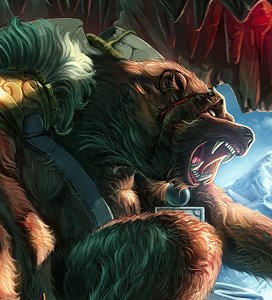
Most of the interview is given over to a discussion of the bear's personal history; the portion that
has bedeviled American creature policy for years consists of roughly ten minutes (usually quoted
rather selectively, when used by bear apologists) near the end of the interview.
Q: Do you ever regret having chosen to wage war against humanity?
I never chose to wage war. I never knew I was in a war. I have simply been living as best and as
freely as I am able. I do not hate humanity, nor did I go out of my way to persecute it.
Q: You don't think you've committed acts of aggression?
I could have destroyed entire cities. I could have killed millions. I didn't.
I did only the minimum I needed to do in order to maintain my freedom. I thought that because I
did not hate you, then I was free of the need to destroy and displace humanity. But I realize now
that I was wrong.
Q: You were wrong? About what?
I should have wanted to wage war against you. I should have wanted to displace you. Not
because I hated you . . . but because it is the logical endpoint of the path to which I was born. My
life has been one of conflict and competition. I chose that life, but I also wasted it. I thought I
was so beautiful and so able because I could beat any individual opponent on Earth. I could beat
a plane, or a bomb, and I could certainly beat a man.
But I've now realized the paltriness of that claim. I was given such power and I was satisfied
with such trash. I should have hated you for all the hurt you have inflicted on me. I should never
have been satisfied at sharing the world with you. My lack of hatred was a defense mechanism. It
was not only cowardice, it was something worse . . . laziness.
Q: Am I to understand that you are announcing a new phase of hostilities against mankind?
Do not try to humor me. We are already in the last phase. I am dying. Your new bullets are able
to mark my body. Your new bombs make me sick and weary. I have tried many times to leave
this mountain and each time I have been driven back. I will die here.
Q: Then why break your silence? Have you decided to surrender yourself?
Never once has any sort of surrender been offered to me. Nor, even in my earlier days, was any
sort of compromise ever forthcoming. I watched you talk to each other on television and in
newspapers and over the radio. You always talked about peaceful solutions. You talked as if you
had made many peaceful overtures to me. There have been none. When your planes and tanks
see me, they fire. There has never been any room for surrender in this struggle.
You have pity for me, I know that. But you do not have enough pity to let me live. And I'm glad
of that. If I'd taken your surrender, it would have been a farce. I would have learned to smile at
you: trained my bearish features to make an expression your dumb eyes would see as a smile.
And then I would have bided my time. Eventually my offspring would have unseated you. I
think sometimes that maybe that was supposed to be my destiny . . . maybe I should have sought
out a peace with you. Maybe I betrayed myself and my God.
Q: Because you never tried to compromise?
No, I never tried. If I had, I think you would have rejected my compromises. But I think . . .
maybe I should have tried.
Q: Yet you say that God put you on earth to achieve some purpose? Do you think you've
achieved it?
I don't know. I cannot see what has been accomplished as a result of my life. Sometimes I think
that God merely sent me as a test for humanity. You have developed many new technologies to
try to kill me. You have been united in new and stronger alliances in order to contain and defeat
me. Perhaps the eventual apotheosis of mankind -- your birth into an earthly kingdom of love,
safety, and prosperity -- has been hastened as a result of my coming. Is that enough of a reason
for my existence? Perhaps it is. After all, it is more of a reason than most men have.
But the thought of that disgusts me. Surely there must be more than that. Surely I am something
better than a mere tool to be used by and for the betterment of mankind . . . Surely I had to have
some kind of value in and of myself . . .
Shortly after this final question, the interview was interrupted by renewed hostilities. The bear
ventured out from the cave and never returned. Seventeen days later, he was found, dead, on a
nearby hillside.
Too many bear apologists are unwilling to look further than these words. They are not honest
enough to conduct the same search of the bear's writings that we have undertaken. They refuse
to see that the bear never renounced its desire to dominate and eventually destroy human society.
Far from being a peaceful overture, the compromise for which the bear was pleading would
merely have been a temporary ceasefire in which to regain its strength.
But even calling for this limited sort of compromise represents a substantial change from the
bear's previous position that it was willing to live and die according to its own strength. We do
not know the bear's motive for breaking its years-long silence, especially since it clearly realized
that no compromise would be forthcoming.
Most teratologists have concluded that this interview simply represents a cowardly breakdown of
the bear's ubermensch persona under the influence of extreme stress caused by the knowledge of
its imminent defeat. Because of this, we do not share the bear apologists' obsession with the final
interview: we do not see it as a useful vehicle for determining the bear's true thoughts and
motivations. To us, these final words constitute the bear's blasphemy.
For this reason, many teratologists feel that the last interview is better off forgotten, and to a
large extent it has been. For most of mankind, the bear is remembered only as one of the most
destructive, beautiful, and silent of humanity's foes.