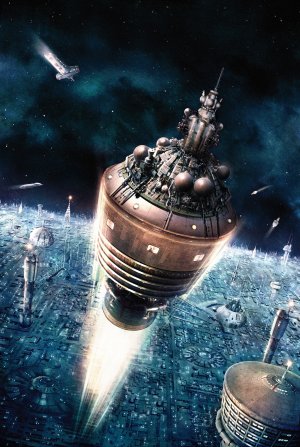
Tabloid Reporter to the Stars
by Eric James Stone
When I was fired after ten years as a science reporter for the New York Times, the
editor told me I'd never get a job with a decent paper again. He was right, at first:
no one wanted to hire a reporter who had taken bribes to write a series of articles
about a non-existent technology in order to inflate the value of a company being
used in a stock swindle -- even if I had managed to get off without serving time.
And that's the only reason I took the job with the Midnight Observer tabloid.
They didn't care that I'd made up a news story -- they were impressed that I'd
managed to write something that had fooled experts for over a year. So began my
new career under the pseudonym of Dr. Lance Jorgensen. The doctorate was
phony, of course, and I never did decide what it was in. I worked that gig for three
years before I caught the break that let me get back into real journalism.
When the United Nations Space Agency decided to hold a lottery to choose a
reporter to travel on board the first interstellar ship, they set strict qualifications: a
college degree in journalism, at least five years of experience as a science reporter,
and current employment with a periodical or news show with circulation or
viewership of at least one million.
Technically, I qualified. So I entered. And a random number generator on an
UNSA computer picked my number.
Less than five minutes after UNSA announced the crew of the Starfarer I,
including yours truly as the only journalist, the calls began. The first was from my
old editor at the Times. He wanted me back on an exclusive basis -- I could name
my own price. I'll admit I was bitter: I told him my price was full ownership of
the paper, and that I'd fire him as soon as I had it. He sputtered; I hung up.
By the end of that week, I had a TV deal with CNN and a print/web deal with the
Washington Post. And so, without a gram of regret, Dr. Lance Jorgensen gave the
Midnight Observer his two weeks' notice. I was once again Lawrence Jensen,
science reporter.
A lot of journalists squawked that I didn't deserve to be on the mission because of
my scrape with the law, even if I had managed to avoid a conviction by turning
state's evidence. But the rules were on my side for a change: my degree from the
Columbia School of Journalism, my experience at the Times, and the Midnight
Observer's seven-million-plus circulation fit the letter, if not the spirit, of the
rules. Despite their fervent wishes, I made it through spaceflight training without
a hitch, and proudly boarded the Starfarer as the world looked on.
This mission was my chance for redemption. I'd made one big mistake, and I
planned to make up for it with accurate, well-written science reporting that made
the wonders of space travel understandable to everyone. I had loved science since
I was a kid; if I'd had the brains to do the math I might have chosen a career as a
scientist instead of a reporter. Reporting this mission was my dream job, and I
was determined not to mess things up.
The day we launched, the Midnight Observer ran a cover story claiming that I had
been selected for this mission because while working undercover for them I had
already met the aliens the Starfarer would encounter, and they had requested that I
serve as Earth's ambassador. They had even 'shopped a picture of me shaking
hands with a stereotypical short, gray, bald, bulge-headed alien.
During all two hundred and twenty-three days of hyperspace travel, my crewmates
refused to let me live that down.
Fortunately, when we found the aliens, they didn't look anything like that picture.
* * *
The theory behind hyperspace travel involves several dimensions
beyond the usual four we humans can perceive. The mathematical
formulas involved in actually making a hyperspace drive work
surpass the understanding of the unenhanced human brain. But what
the formulas and the theory don't mention is that traveling by
hyperspace is beautiful. The harsh radiation that fills the
hyperspacial void becomes a kaleidoscope of infinite variety as it
washes upon our magnetic shields.
* * *
Observations from Hubble III had indicated the possibility of a planet with an
oxygen-nitrogen atmosphere in this system, and now that we had arrived, our on-board telescopes had confirmed that the fourth planet had such an atmosphere. I
had just finished my third column for this week's homelink, explaining about non-equilibrium gasses and why this meant there was life of some sort on the planet,
when Singh began pounding on my cabin door.
"Hey, Ambassador, you in there?"
I didn't dignify that by responding.
"Come on, Jensen, open up. I've got a scoop for you."
Narinder Singh was one of Starfarer's xenobiologists, and until we actually got
down on the ground, he didn't have much to do except make guesses based on the
limited data our telescopes could gather. So it was unlikely that he had anything
important. Besides, since I was the only reporter on board, there wasn't anyone
who could scoop me. But I said, "Come in," anyway.
He opened the hatch and came in. "Look at these." He shoved a handful of eight-by-ten photos in front of my face.
I took the photos and began leafing through them. They showed a thin sunlit
crescent of planet, which I assumed to be Aurora, the planet with the good
atmosphere. "So, it's nighttime on half the planet. Excuse me while I call my
editor and tell him to stop the presses."
"No, look closer at the nighttime side. Over here." He pointed to a region along
the equator near the edge of the darkness.
Peering at the photo, I noticed that there were a dozen or so little clumps of bright
spots. "You think these are the lights of cities?"
"Yes. There's a civilization on that planet. And I want you to remember I came to
you with this discovery first."
I looked over at the column I had just finished. I could rewrite a bit to mention
Singh's speculations, with plenty of caveats. But it still seemed a little too flimsy
-- and the whole situation with the Midnight Observer story made me leery of
anything involving aliens. "Yeah, I'll remember, if it turns out to be anything. It's
probably volcanoes or forest fires or something. Did you run this by Khadil?"
Iqrit Khadil was our geologist. "I mean, if it's really a civilization down there,
how come there's no radio traffic?"
"Maybe they haven't developed radio yet. Or maybe they've moved beyond it.
But I'm telling you, this is it: a sentient species with at least rudimentary
civilization."
"Look, if you can get Khadil to agree that those are not volcanoes or any other
geological phenomenon within the next half hour, I'll put your speculations in
today's column. Otherwise, you'll have to wait till next week, which might be
better, anyway, since by then there might be more evidence one way or the other."
He grabbed the photos back. "I know what I know. I'll talk to Khadil."
* * *
Now that the Starfarer is out of hyperspace, normal radio
transmissions would take over one hundred and thirty years to travel
to Earth, making direct two-way communication impossible. So the
Starfarer's designers came up with a solution. When we arrived in
this solar system, our ship split into two modules. The Hyperspace
Module (HM) and two members of the crew remain in the outer
system, where they can make the jump to hyperspace, while the
Orbital Module (OM) heads in toward the planets with the rest of the
crew. We send all our data -- including this column -- to the HM.
It takes six days for the nuclear reactor on the HM to store enough
power in the capacitors for the jump to hyperspace. So once a week,
they make the jump and send a radio signal to a ship in hyperspace
near Earth. Instead of one hundred and thirty years, the signal only
takes eighteen hours to travel to Earth. The receiving ship then
returns to normal space and transmits the data to UNSA
headquarters on Earth, which sends my columns to the Washington
Post, who deliver it to your doorstep.
* * *
By the time the OM reached planetary orbit five days later, all the evidence
pointed to a developing civilization on Aurora, so I decided it was a good thing I'd
included Singh's speculations in my column. We didn't know what the reaction
from Earth was yet -- the HM was still charging its capacitors for its weekly jump
into hyperspace to transmit our reports and download communications from home.
But first contact with an alien species, which had always been considered only a
slight possibility, transformed our mission from one of simple exploration into
something far greater. I'd already written and rewritten and disregarded several
columns about the meaning of all this. It was probably the biggest news story
ever; I was writing history, and I wanted to get the words right.
I wasn't the only one. Commander Inez Gutierrez de la Peña, who was in overall
command of our mission, commed me in my quarters in the middle of the night.
The next morning most of the crew would be taking the Landing Module down to
an isolated island in the middle of Aurora's larger ocean, and she would take the
first human step on a planet outside our solar system. She wanted my opinion on
what she would say upon taking that step.
I was flattered, but feigned irritation out of habit. "It's two in the morning.
How'd you know I wasn't sleeping?"
"I checked the power consumption in your quarters and could tell the lights and
your computer were on." UNSA hadn't picked Gutierrez by lottery; she knew this
ship six ways from zero.
"OK. Tell me what you've got so far."
She hesitated a moment. "It's no 'One small step,' but . . . 'Humanity has always
been a race of explorers. Though in the past we have not always lived up to our
aspirations, letting fear and exploitation rule our encounters with the unknown,
today on this new world we have a chance --"
"Blah blah blah. Are you looking to write a pamphlet on social responsibility or
do you want to say something that will still be quoted a thousand years from
now?"
"I was thinking that putting the event in its historical context --"
"Leave that to the historians and people like me. What you need is a sound bite.
Short. To the point, yet something that recalls the dreams of our first ancestors
who looked up at the stars and wondered what lay beyond them."
On my com screen, her face nodded. "I see what you mean. You going to be up a
while longer?"
"Yeah. Call me when you come up with something."
I may not have sounded very respectful, but Commander Gutierrez had my respect.
Not only was she almost irritatingly competent at her job, but out of the thirty-seven other members of the crew, she was the only one who had never called me
"Ambassador."
It took her six more tries over the next three hours before I thought she had it
about right.
The next morning, precisely on schedule, she climbed down the ladder outside the
LM's airlock. We could hear her steady breathing over her spacesuit's com
system. When she reached the bottom and took that first step onto Aurora's soil,
her voice came in loud and clear.
"Today humanity walks among the stars. Where will we walk tomorrow?"
As those of us on board the LM clapped and cheered, I felt twin twinges of pride
and jealousy. Every word I had ever written would be long forgotten, and still
those words would be remembered. They were not mine, but at least I had helped
shape them.
I took my little shares of immortality wherever I could.
* * *
Like the generation who as children saw the Wright Brothers fly and
as adults saw man walk on the moon, or those who watched the latter
as children and lived to see the first colony on Mars, we are witnesses
to the dawn of a new age of humanity. Who knows how far we will
go, following the footsteps of Commander Gutierrez?
* * *
Our landing spot's isolation allowed the biologists to analyze the native life with
the least risk of contaminating the planetary biosphere. Seven days after landing, I
got a chance to take a five-minute walk around the island. Aurora's light gravity
-- seventy-eight percent of Earth's -- gave a spring to my step despite the weight
of the spacesuit.
I daydreamed of spotting something significant during my walk, a scientific
discovery of my own that I could reveal to a waiting world, but in the end all that I
had discovered for myself was the sensation of walking beneath an aquamarine
sky and looking up at a sun that seemed too blue and too small.
As far as important discoveries went, I had to settle for the daily breakthroughs of
the biologists. The biggest one was the fact that life on Aurora was not based on
DNA, but rather on a previously unknown nucleic acid molecule with a hexagonal
cross-section. A few days later came the finding that the protein building-blocks
of Auroran life consisted of twenty-two amino acids instead of just twenty.
Exciting and heady information though these details might be for the fraction of
Earth's population who were molecular biologists, I needed a subject that would
grab the average reader's attention. That meant either danger or sex or both --
suitably phrased for the Washington Post, of course. I abandoned my half-written
amino acid column and went down to the biolab to wheedle something worth
writing about out of the biologists.
Singh was in the middle of something delicate and didn't have time to talk, but
Rachel Zalcberg said she could spare a few minutes while she waited for some test
results.
About three months into the hyperspace flight, I'd made a pass at Rachel. She'd
shot me down in no uncertain terms. Asking her about alien sex was definitely not
the right place to start, so I focused on danger. "Since life here on Aurora is so
different, how likely is it that there is some sort of disease organism that our
immune system can't handle?"
She waved a hand dismissively. "Most disease organisms have trouble crossing
the species barrier. Genetically, you're closer to an elm tree than to anything here,
and you don't have to worry about Dutch elm disease. Our biochemistry is so
different, the Auroran equivalents of bacteria and viruses wouldn't be able to
reproduce inside us, assuming they even managed to survive at all."
That ruled out the danger angle, but since she'd brought up the subject of
reproduction . . . "How do the animals here reproduce?"
She surprised me by grinning. "You will not believe how different it is. It's very
exciting. I haven't had a chance to write this up yet, but I will before the next
homelink. Just be sure to credit me with the discovery when you talk about it in
your column."
"Of course." I leaned forward.
"Our initial examination showed that all the life here is asexual: There are no
divisions between male and female."
"I know what asexual means." It meant biologist exciting, not reader exciting.
"We are isolated here, so it may not hold true for the whole planet, but for now it's
all we have. Some of the life here reproduces by budding, essentially splitting off
a little clone of itself. However, that doesn't account for the genetic diversity
we've seen within species. And then we caught some of our lab specimens being
naughty."
"Naughty? I thought they didn't have sex."
"Not exactly. One of our furry slugs -- we haven't come up with a scientific
name for it, yet -- ate another one. Swallowed it whole."
"Cannibalism?" Maybe there was something here after all.
"Reproduction. After a few hours, that slug's skin hardened into a sort of cocoon.
Two days later the cocoon cracked, and out came four smaller furry slugs. And
each of the four is genetically different, with two-thirds of the genetic material
from one slug, one-third from the other. Two slugs died and four were born."
It was good enough for one of those more-things-in-heaven-and-earth-than-are-dreamt-of-in-your-philosophy columns. I even got some footage of the new furry
slugs for my CNN commentary.
I had the biologists to thank for the other highlight of that week. Coupled with the
chemists' analysis of the atmosphere which showed there were no threatening
toxins, the biologists' report that there was no significant disease threat meant we
were authorized to go outside without spacesuits, and breathe fresh air for the first
time since we'd left Earth almost nine months before.
I jumped at the chance to be one of the first group to breathe the unfiltered air of
another planet. The airlock door hissed open. I took a deep breath, and gagged on
an aroma reminiscent of wet dirty socks.
That footage did not make it into my CNN commentary.
* * *
Opponents of contact with the Auroran civilization point to the tragic
experiences of indigenous societies on Earth after contact with more
technologically advanced societies. Indeed, the histories of Native
American tribes, Australian aborigines, Native Siberians and many
others prove that such contact can be disastrous. But isn't the whole
point of learning from history the idea that we can do better? If
humanity could not progress, if we were forever destined to remain
the same barbaric species that came out of the caves, then we would
not even be debating this issue: we would be out conquering the
Aurorans to use them as slave labor. Yes, our past demands that we
proceed with caution, but our future demands that we proceed.
* * *
Perhaps the approval from UNSA would have come anyway, although I like to
think my columns in favor of contact with the Aurorans had some effect. Our
supplies limited us to only six months on the planet before we would have to begin
the return journey to Earth, but we would be able to spend the last two of those
months near an Auroran city.
We had refilled our fuel tanks by using electricity from our nuclear power plant to
derive hydrogen and oxygen from seawater, and we would need to do so again
before leaving, so we selected a coastal city as our destination and began our
suborbital flight toward first contact.
"How you think they look?" asked Gianni Cacciatore, our climatologist, a few
minutes after we launched. "If they are gray humanoids with bulging heads, they
greet you as an old friend, ehi, paesano?"
There was Italian ancestry on my mother's side, so he'd taken to calling me
paesano, countryman. At least it was better than Ambassador. I couldn't avoid
talking to him, since we were strapped into seats next to each other for the
duration of the flight. "Look, that Ambassador thing is getting about as old as
someone asking you to go do something about the weather instead of just talking
about it."
He thought a moment, then laughed. "Buffo. But what you think? I want to say,
you are the only that knows something of the research of everyone. You have the
grand picture."
It was a good question, actually. Our only pictures of the Auroran cities came
from the Orbital Module, and its orbit was too high up to show individual
Aurorans as anything more than a few pixels. In order to avoid any possible
contamination, our initial landing site had intentionally been far from any sign of
Auroran civilization. So none of us knew what an actual Auroran looked like. I'd
discussed the issue with the biologists but hadn't written it up because it was pure
speculation.
"Well, based on the animals we've discovered so far, the Aurorans are probably
bilaterally symmetrical, although it could be quadrilateral. Since they have a
civilization, they must be tool users, which means they must have something like
our arms and hands, though it could be tentacles with claws for all we really know.
They must have a way of getting around, so legs are probable, but we can't really
know how many. Or maybe they move like snakes or snails." I sighed. "What
I'm basically trying to say is that there are so many possibilities that we haven't
got a really good idea of what they will look like, but they probably will not look
as much like us as the stupid fake alien in that photo does."
He nodded. "Interessante."
I shifted the conversation to some of the unusual things he had discovered about
Aurora's climate and thus kept myself occupied until our pilot, Zhao Xia,
announced that we should prepare for a jolt when she activated the engines to slow
us for landing.
The LM's cabin was mostly silent as we watched the ground grow ever closer on
our screens. When we touched down, there was some clapping and cheering,
though not as much as there had been the first time we landed.
Commander Gutierrez's firm voice came over the intercom. "I'm sure the
Aurorans nearby must have seen us coming, and some of them will probably arrive
soon. Those who were chosen for the first contact party please prepare to exit the
ship."
I had demanded to be included in the party, and Gutierrez had refused. Although
it seemed unlikely, there was no way to be sure the Aurorans would not react with
xenophobic violence, so she had decided to send only two people: Singh, because
of his xenobiological expertise, and Tinochika Murerwa, because prior to
becoming an astrophysicist he had seen combat while serving in the U.N. Special
Forces.
My arguments in favor of freedom of the press did not persuade her, but I made
enough of a fuss that her superiors on Earth had ordered her to include me. I don't
know why they overrode her; I suspect the real reason had nothing to do with
freedom of the press and everything to do with the fact that the United States
shouldered forty percent of the cost of this mission, and U.S. politicians wanted an
American involved in the biggest news to come out of it. It didn't matter why -- I
was in.
Singh, Murerwa and I gathered our equipment and entered the airlock. As the
pressure equalized, I said, "Good luck, Singh," because he was the one in
command of our little party.
"Thanks."
We climbed down the ladder and started preparing for our hosts to arrive and greet
their unexpected visitors.
Murerwa looked over his shoulder at the videocam I was setting up on a tripod.
He let out a deep bass laugh. "Planning to get a picture of yourself shaking hands
with a real alien?"
"Yes." Somehow I felt that getting a real picture would be my compensation for
all the grief I'd taken over the fake one.
After a very long five minutes, something came over a small ridge east of us. As it
got closer, I began to make out details of its physiology. It looked like a scaly
brown headless camel with four tentacles instead of a neck. As it got closer, I
could see a wide opening between the top and bottom pairs of tentacles that I
presumed to be its mouth.
It stopped about ten meters away from us. It wasn't very large; although it
certainly weighed more than me, the hump on its back only came up to about the
middle of my chest. As if responding to that thought, the hump rose a few inches
on a thick stalk, and the creature seemed to stare at us out of two glossy blue-black
openings on the front of the hump.
Singh said something in Hindi that I didn't understand.
"Is it one of the Aurorans or just an animal?" I asked.
"I think it's sentient. It's wearing something like a tool-belt around one of its
forelegs."
Now that he pointed it out, I saw the belt, which appeared to be made of a thick
woven fabric. And one of the tools was undoubtedly a hammer, even if I wasn't
sure what the rest were.
We stared at him while he stared at us. Now we knew what an Auroran looked
like.
Or rather, we thought we did until more creatures began coming over the hill.
Some came on four legs, some on two. I was fairly sure I saw one with eight.
Some had tentacles; others had jointed arms with hand-like appendages. All had
scaly skins, but some had patches of fur that appeared to be part of their bodies,
not clothing, and all had heads similar to the hump on the first one, though it
didn't seem to be in the same place on the different anatomies. Some were
bilaterally symmetrical, but some were not -- I spotted one that had anemone-like
tendrils on one side and a crab-like pincer on the other. And of the fifty or more
arrivals, there didn't appear to be more than a handful that looked like they
belonged to the same species.
As the crowd grew, they began singing to each other. At least that's what it
sounded like to me; wordless tunes that harmonized rather than creating a
cacophony.
Then one of them said some words, and the others silenced almost immediately.
"Did you catch what he said?" asked Singh.
"Sounded like 'Alla Beeth' to me," I answered.
A voice in the crowd repeated it, and suddenly all of them were chanting, "Alla
Beeth."
They didn't stop chanting until the soldiers showed up. Their civilization might
be very different from ours, but a sword still looks like a sword, even if it is
strapped to the waist of a tentacled reptilian centaur.
The soldiers sang to the crowd, and the crowd quieted down, parting in the middle
to allow the half-dozen soldiers through.
Their leader trotted forward through the buffer zone the crowd had left around us,
and stopped about two meters away. His wide, expressionless eyes looked at each
of the three of us in turn. Then he edged sideways until he was standing in front
of me. Slowly he drew his sword.
I bravely stood my ground to show the aliens that humans were not intimidated.
Or else I was frightened into immobility. Either way, the result was the same.
The leader bent one of his forelegs and sort of knelt on one knee. He placed his
sword on the ground, looked at me, and said, "Alla Beeth."
The crowd took up the chant once more.
Murerwa laughed again. "Looks like you've been chosen as the first ambassador
to Aurora."
* * *
The failure to include a linguistics expert on this mission is not as
unreasonable as critics of UNSA are claiming. The evidence showed
a high likelihood of a planet with an oxygen-nitrogen atmosphere, but
before the Starfarer arrived there was not a scintilla of evidence for a
sentient, civilized lifeform in this system. Earth has had an oxygen-nitrogen atmosphere for perhaps 1.5 billion years. The chances that
an alien ship visiting Earth during that time would have had found
humans are only a third of one percent. The chances it would find us
civilized are less than half a thousandth of a percent.
* * *
Iqrit Khadil was the first to bring up religion. During a lull in mess hall
conversation as the crew ate dinner the night of first contact, he said, "I do not
think it can be merely coincidence that one of the two words we have heard these
aliens speak is Allah."
"You can't be serious!" Rachel said.
"Why not? These primitives obviously seemed to think Jensen was a god, or a
messenger sent by a god. And though they seem to communicate among
themselves by singing, they knew to speak words to us. And one of those words
was Allah."
Rachel's knuckles tightened around her fork. "All right, O wise one, then what
does 'Beeth' mean?"
Khadil shrugged. "Maybe it means messenger. 'Allah Beeth,' messenger of
Allah."
I almost said that if I was anyone's messenger, I was the Washington Post's, but
several people began talking at once.
Rachel pounded the table with her fist until everyone turned to look at her. "First
of all, we don't know how the words are divided, or even that it's more than one
word, or even that it's a word at all. Maybe the first word is Al, but they're really
just mispronouncing El, and so they're actually referring to the God of the Jews,
not the God of Islam." She raised her voice over the beginnings of objections.
"But coincidence is the most likely explanation. If we are going to speculate
based on the idea that they spoke to us because they have seen humans before --
which I find hard to believe -- then there are other reasonable explanations. For
example, they were trying to say the first two letters of the alphabet. Everyone
here is familiar with the first two letters of the Greek alphabet: alpha, beta. In
Hebrew, they are aleph, bet." She turned to Khadil. "What are they in Arabic?"
"Alif, ba." He nodded. "I spoke too soon. I was just excited to hear what sounded
like 'Allah.' But it is most likely a coincidence."
During the rest of dinner I thought about what Khadil and Rachel had said.
Coincidence. The possible meaning of the words didn't really matter to me. But
if the Aurorans communicated through song, why did they have words to use with
us? And why only two words?
I tried to avoid wondering why their leader had chosen me to bow to, but I wasn't
very successful.
* * *
Imagine if eating an octopus in a certain way would allow you to
grow tentacles on your body. Or if by eating a horse, you could
replace your two human legs with four horse legs. According to
Singh and Zalcberg's observations of our newfound friends, that is
essentially what the Aurorans can do: manipulate their own bodies
by absorbing an animal and using its genetic code to recreate some
aspect of that animal's body. The wide variety of body shapes and
parts among the Aurorans comes from deliberate change, not from
their inherited genes.
* * *
Within a few days, the Aurorans remedied our failure to bring a linguistics expert
by providing one of their own. His name was a short trill that most of us could not
reproduce, so someone called him Mozart. I pointed out that, given "Beeth" was
one of the two words he knew, Beethoven might have been more appropriate, but
by then the name had already stuck.
Biologically speaking, Mozart was neither a he nor a she, but none of us really felt
comfortable calling it "it." Since the real Mozart had been a he, we defaulted to
that usage for the most part.
Through trial and error, we determined that the Auroran vocal apparatus
simply was incapable of making most of the sounds of human languages.
Fortunately, Mozart had brought rough sheets of a paper-like substance,
inks of various colors, and a collection of clay stamps that could be
used to imprint various symbols on the paper. While a few of the
simpler symbols bore a resemblance to letters in various Earth alphabets
-- X, O, I, T, Δ, Λ, Γ -- there did not appear to be any
connection between them and their Earthly sounds, so Rachel's
aleph-bet explanation for "Alla Beeth" was a dead end.
Since Mozart understood the concept of written symbols representing ideas, once
he got over his astonishment at the interaction between a computer keyboard and
monitor, we were able to teach him to use his tentacles to type. We would
communicate back by typing and saying words at the same time, so he could learn
to associate the text of a word with its sound.
Whoever had decided to send Mozart to communicate with us had made a good
choice. After only four days, he had learned enough English to carry on simple
conversations, so during my shift for teaching him, I asked him the question that
had been bothering me. "Why did your leader bow to me?"
<What is my leader?>
"One of your people with swords. The most important one."
<Commander Gutierrez is your leader?>
"Yes."
<What is bow?>
I demonstrated a bow.
<Not my leader. Leader close people. I is far.>
The nearest town, which someone had imaginatively dubbed Neartown, was not
the place Mozart was from. That was new information, and I felt a little pleased
with myself for discovering it. Still, I pressed on to find out more about what was
bothering me. "Why did the leader of the close people bow to me?"
<He think you is How do you spell?> He stopped typing and said, "Alla Beeth."
I typed it out for him.
<He think you is Alla Beeth.>
"You do not think I am Alla Beeth?"
<No. You look like but not same.>
"Who is Alla Beeth?"
Mozart whistled a staccato tune. <You not know Alla Beeth?>
I thought fast. If Alla Beeth was some sort of deity and I denied knowledge of it, I
wasn't sure what sort of complications that would cause. "Our language is so
different from yours that our name for Alla Beeth may be different too." I hoped
that wasn't some sort of heresy.
<Alla Beeth is first of your people to visit our people.>
I felt the tremble in my stomach that I get when I realize I'm on the verge of a
major story. "When did Alla Beeth visit your people?"
<Is fifty years more.>
Fifty years. Their planet's year was more than two Earth years long, so he was
claiming a human had visited Aurora over a hundred years ago, back before we'd
even walked on Mars.
"Wait a minute." Even though this was being recorded, I wanted someone else
with me before I proceeded any further. I commed Commander Gutierrez and
asked her to come join us.
After reading the transcript of our conversation to that point, she asked, "Is this a
joke?"
"If it is, someone's setting me up. I swear I had no idea he was going to say this."
She nodded, then turned to Mozart. "Did someone tell you to say that Alla Beeth
was human?"
<I not know Alla Beeth is human before I see humans. Then I know. No one tell
me.>
Gutierrez typed and spoke slowly. "Mozart, we are the first humans to visit your
people."
Mozart let out a long, descending note, and began typing furiously. <No. Alla
Beeth is first. Is long time. Six my mergings but I remember. He come sky. He
clothes all white. He like bright. He talk our language but we slow understand.
He here small time. He go sky. Fifty years more you come.>
Gutierrez and I looked at each other.
<You not believe Alla Beeth? How not believe Alla Beeth?>
I looked into Mozart's shiny black eyes. "I believe you, Mozart." He believed
that this Alla Beeth had visited his world, and even if I couldn't believe it was a
human, I was sure that something must have visited the Aurorans.
* * *
Merging requires much more commitment than human mating,
because neither of the Aurorans involved will survive. The larger of
the two Aurorans swallows the other whole to begin the reproductive
process, then hardens its skin into a thick shell. After about eighty
days of cocoon-like existence, four small Aurorans break out of the
shell to begin their lives. But their minds are not blank slates. In
addition to a genetic heritage from both adults, each new Auroran
carries a portion of the memories from the brains of its parents.
Some Aurorans can remember events from over a thousand years
ago.
* * *
This time it was Cacciatore who brought up religion, breaking the stunned silence
after Commander Gutierrez and I had shown the rest of the crew the recordings of
our conversation with Mozart. "If nobody else say it, I will. Technology could
not have brought a human here before us. Only the power of God."
The racial and religious proportionality requirements during the crew selection
process had been intended to represent all of Earth in our tiny ship. Not
surprisingly, the scientific community had undergone a small religious revival
when those requirements were announced. So, no matter how recently converted,
we had a good cross-section of religious belief on board.
Some of the Christians in the crew backed Cacciatore's theory that the visitor had
been an angel; others thought it had been Jesus himself. A few of the Muslims
could accept the idea of an angel, but insisted that Allah must have sent the angel.
The rest of the Muslims supported Khadil, who insisted that the visitor must have
been Mohammed. The Hindus spoke of the possibility that it had been one of the
avatars of Vishnu. Rachel, as the only Jew on board, was arguing against all sides
at once, while admitting the barest possibility that the visitor was an angel.
Commander Gutierrez mostly succeeded in remaining above the fray. The atheists
and agnostics stayed out of it, as did the Buddhists.
As for me? From when I was four years old until I was eighteen, I alternated
weekends between my mom and my dad. Sundays with my mom meant going to
church; Sundays with my dad meant watching TV on the couch or playing catch in
the yard while listening to his old-time music collection. By the time I was
fourteen, I pretty much felt that I took after my dad more than my mom, at least as
far as preferred Sunday activities went, and my mom eventually quit asking me to
go with her.
So I stuck with the atheists and agnostics in trying to ignore the potential religious
aspect of Alla Beeth.
Nothing was settled that night, of course. But the hard feelings engendered by the
argument disrupted the work the various scientific teams had been doing. Over
the next few days as I tried interviewing different scientists about their work, I
could see that the crew had fractured: whenever possible, they avoided their
colleagues who were on the "wrong" side.
Mozart didn't help in resolving the dispute. In fact, when he revealed that he
could not show us a picture of Alla Beeth because the Creator had commanded
against making images of living things, the arguments erupted with new fervor.
* * *
There are several possible rational scientific explanations for the
Aurorans' visitor, none of which involve the intervention of any god
or other supernatural entity. Since the Aurorans have no pictures of
the visitor and are relying on memories passed through several
generations of mergings, it is possible that some significant details
have become distorted, and a natural event has been imbued with
mystical significance. Our descent from the sky was then connected
to memories of that event. Another possibility is that the visitor was
from another alien race, one which is humanoid in appearance.
Under the theory of convergent evolution, it is quite possible that an
intelligent, tool-using species could look superficially like us -- even
some of the Aurorans walk on two legs, have two arms, and have a
head with two forward-facing eyes. Perhaps we will encounter such
a race in a few years and be able to resolve this mystery. Until we
have actual evidence, though, nothing about "Alla Beeth" can be
said with any certainty.
* * *
"He trusts you more than any of the rest of us." Commander Gutierrez sat on my
bed, facing me in my chair. Her voice was tired.
"Maybe so, but he believes Alla Beeth was a human, and I don't think I can
change his mind."
"There has got to be more evidence than these memories and traditions. Some
artifact left behind. Something. The crew is splitting apart: I spend all day
ordering people to share their data with each other. Some of them have actually
gotten physical. I'm sure part of it is just the stress of the mission, but this
mystery has pushed us to the breaking point. We need proof that this is something
explainable by the laws of science, like you said in your column. Then, I think
people will calm down."
I shrugged. "What can I do? I'm just a science reporter, not a scientist."
"Mozart and his people see you as our ambassador." She gave a half-laugh, half-sigh. "I've been careful never to call you that, you know. But I didn't try to put a
stop to it, either. Interpersonal dynamics: people need a scapegoat, and I felt you
could take the jokes. But now, I need you to be the ambassador. Ambassador
Lawrence Jensen, descending from the sky with the full unity of Earth behind you.
Push Mozart, push his people, until they show you everything they know,
everything they have. Find the truth."
Find the truth. Scientist or reporter, it distills to that: Find the truth.
* * *
The nearest large city, which we call Metropolis, has a massive
building near its center that rivals the old cathedrals of Europe in its
intricate craftsmanship. Since only members of a certain priest class
are allowed to enter, most Aurorans have never seen what it looks
like from the inside. Mozart is a member of that class, and he
explains that it is a place of scholarship. It was from that building
that he was sent to find out if "Alla Beeth" had truly returned.
Though we proved to be a disappointment to that hope, he stayed on
to learn from us, as we learn from him. Despite the vast evolutionary
and cultural gulf between our people and his, he has become our
friend and has come to trust us. I leave it to you, the reader, to draw
your own conclusion from that.
* * *
<Ambassador means you are the representative of all humans?>
"Yes," I lied.
<Then you are the most important one, not Commander Gutierrez?>
"She is in charge of the ship that brought me here, but I am the Ambassador."
He bobbed his head affirmatively, a gesture he had learned from us.
"One of my functions is to find the truth, and report that truth to my people."
Mozart piped surprise. <You are a Seeker of Truth?>
After six weeks, his English was good enough that I knew the capitalization was
not accidental. "Yes, I am a Seeker of Truth." And I'm willing to lie in order to
get it.
<The Seekers of Truth is the name of my order.>
"What you have told us about Alla Beeth is causing arguments among my people.
I must find a way to resolve those arguments. I must find the truth. Is there
anything more you can tell me or show me about Alla Beeth?"
He tapped the tips of his tentacles against his forelegs for a few moments. <You
must come with me to the place of my order. Since you are a Seeker of Truth, you
should be allowed to hear the message of Alla Beeth directly.>
I suppressed a grin and replied gravely, "I would be most honored."
Commander Gutierrez had one of the pilots take us in the blimp, so we arrived in
Metropolis before sundown.
It took him nearly half an hour of consultation with members of his order before
he came over to me and began typing on the portable computer we'd brought with
us.
<They have agreed that since you are a Seeker of Truth from your world, it is
permitted for you to enter our church.>
"I thank them."
<Though they are in our language, the messages of Alla Beeth are difficult for us
to understand, even after years of study. That is why only members of my order
are allowed to hear them directly, and we then pass on what we learn to the rest of
the people. Since you do not understand our language, I do not know that you will
find any truth in them. Yet Alla Beeth was human, so perhaps you will. And there
is something more, something that I cannot tell you, only show.>
He led the way, and I followed him into the cathedral.
I probably hadn't been in a church more than a dozen times since I stopped going
with my mom, mostly as a tourist. I could tell that the Aurorans had spent years of
painstaking effort in creating this building, carving delicate patterns into solid
stone. We passed through various archways and doors, and I started to hear
Auroran voices harmonizing. Finally we entered a round room; about twenty
Aurorans stood in the middle, singing.
I felt a chill on the back of my neck, like I used to get sometimes listening to the
choir at my mom's church. But there was something more; there was something
about this tune that made me nostalgic, homesick even. It felt like a memory that I
couldn't quite pull from the depths of my mind.
Then Mozart walked to a curtain that hung on one of the walls and pulled it back.
There, in violation of one of their commandments, was a painting of a man --
definitely human -- dressed all in white.
My childhood Sunday memories came flooding back, and between the music and
the picture there was no doubt in my mind as to who had been the first ambassador
from Earth.
"Alla Beeth" was the Aurorans' way of saying "Elvis."
* * *
Anyone else on this expedition would have to be taken seriously. But not me. I'm
a proven liar. Even worse -- I'm a tabloid reporter. I would be accused of
fabrication, of planting the evidence, of corrupting Auroran culture as part of some
tabloid hoax.
The biggest story of my career had fallen in my lap, and I couldn't tell anyone
without ruining whatever credibility I had managed to regain. Whatever powers
that be must not want the publicity.
Of course, my mom would say this was punishment for having lied.
* * *
"Thank you for sharing the secrets of Alla Beeth with me," I told Mozart as we left
the cathedral.
<Did you find what you need to stop the arguments among your people?>
"You were right: Alla Beeth is human."
Mozart trilled joyfully.
"But his message is intended for your people, not mine." I sighed. "You were
right to keep the image hidden. You must keep it hidden, because my people
would not understand. They would reject your belief in him."
After a pause, Mozart asked, <Then what will you tell your people?>
"The truth," I said. "I will tell them the truth."
* * *
I refused Commander Gutierrez's request for a private briefing on what I'd found,
insisting instead on speaking to the assembled scientists. After everyone gathered
outside the LM, I sat on the rim of the airlock and recounted exactly what
happened up until the moment Mozart pulled back the curtain and revealed the
picture of Alla Beeth. Then I stopped.
After a long pause, Khadil said, "Did you recognize the person?"
"He was a human," I said. "Unmistakably. We are not the first to travel the stars.
But as for who it was . . . You really want to know the truth?"
"Yes," said Cacciatore.
"Do you?" I looked at him. "If I say it was Mohammed, will you become a
Muslim?" I turned to Khadil. "If I say it was Moses or Elijah, will you become a
Jew?" I shook my head. "You want me to give you scientific proof of your
religious beliefs? Well, I'm not going to; it's called 'faith' for a reason. Here's
the real truth: you've all been acting like a bunch of ignorant yahoos, not the
cream of Earth's scientists. So quit bickering and get back to work."
I rose, turned my back on them and stalked through the airlock into the LM.
Commander Gutierrez caught up with me just outside my quarters. "That's it?
That's all you're going to say?"
I stopped. "Yes."
She looked at me appraisingly. "You know they'll all hate you for that little show
and not-tell."
I shrugged. "As long as they're united again. . . That's what you wanted, right?"
Gutierrez nodded. "Just between you and me, though, who was it in the picture?"
Cocking an eyebrow, I said, "Assuming it was one of the great religious leaders of
the past, how on Earth -- or Aurora -- would I know him from Adam?" I hit the
button to open the hatch to my quarters. "Now, if you'll excuse me, Commander, I
have a column to file."
* * *
The mystery of just who Alla Beeth was and how he got to Aurora
may never be fully explained. But as Earth's first ambassador to
Aurora, he prepared the way for peaceful relations between our two
worlds. And for that, we can only say, "Thank you, thank you very
much."