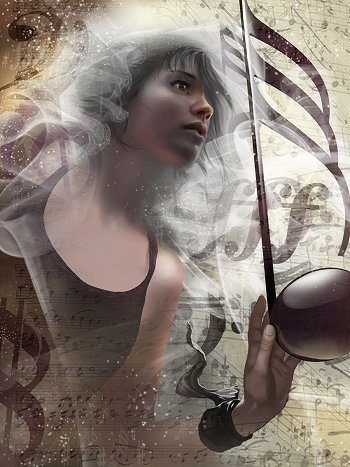
Notes on a Page
by Barbara A. Barnett
Yesterday Maestro Fuhrmann took the Beethoven so fast I was gasping for breath; today I'm
wondering if I'll make it to the end of the phrase before turning blue in the face. Rehearsals like
this leave me wishing I had learned violin instead of oboe -- string players aren't encumbered
by the limits of their lungs. But as the maestro is so fond of reminding me, I have another
limitation to worry about.
"Feeling, Ms. Adams!" he says, his German accent as thick as his eyebrows. Every criticism
begins with those same words, that same exasperated tone of voice that makes me want to crawl
inside the music and hide behind the staff lines. "Beethoven wrote a piece full of passion. You're
just playing notes on a page."
As if there's no passion to be found in that. In precision. One note under pitch, one late entrance,
one sustain held a second too long and an entire piece can collapse into cacophony. And so I
play in service to the way every single musical element comes together with mathematical rigor
to form a seamless whole -- at least in theory. In practice, I am alone among my fellow
musicians, the eccentric who refuses to impose some abstract sense of emotion upon technical
perfection.
The maestro moves on to entreating the strings to give him a fuller, more bombastic sound.
While he sings the phrase at them in that overly theatrical way of his, Josef, the principal flautist,
tries to catch my eye from his seat two stands down. A subtle lean forward, an unsubtle smirk.
He mouths "Mozart" and points to my music stand.
Great. Another one of his love notes.
I pull the Mozart concerto out from behind the Beethoven. Josef's handwriting, as artsy as that
ridiculous beret he wears, fills the left margin: You + me = plenty of feeling. I'm amazed there
isn't a slime trail to accompany the winking smiley face he's drawn. I grab a pencil from the lip
of my stand and start erasing so vigorously that the music tears.
"Again," Maestro Fuhrmann calls out. "Top of the page."
Too quickly, I shove the Mozart back behind the Beethoven; the music crinkles. Too slowly, I
raise my oboe to my lips; my entrance is late, my embouchure ill formed. I come in with an
under-pitch squawk. The maestro glares in my direction. If there's one thing he despises more
than my lack of feeling, it's amateurish mistakes.
When he finally calls for break an hour later, I rush from the stage, my eyes fixed on the floor. I
manage to avoid Josef, but my escape route takes me past the conductor's podium, where I
overhear the maestro muttering to the concertmaster about "reconsidering the sound of the
orchestra." I've been here long enough to know what that means: at the end of the concert
season, someone will be asked to leave. I don't need to guess which player he has in mind.
It's one disparagement too many. I flee to the bathroom and splash cold water over my burning
cheeks. Our last music director was more forgiving of my "charming idiosyncrasies," as he
called them. But Fuhrmann -- I'll never be able to give the man what he wants. The only
feelings he's ever roused from me are embarrassment and shame.
By the time I've collected myself enough to head to the musicians' lounge, it's already 11:25 --
only five minutes of break left. I hurry across the room, cringing at the disarray that surrounds
me. As ordered as we are onstage, neatly aligned by instrument and stand number, here the
idealized, audience-perspective vision of an orchestra collapses. Chairs have been scattered
every which way, dragged across the room so many times you can see their paths worn into the
frayed carpeting. A half-played game of chess sits on one table; outdated magazines and days-old newspapers lie strewn across another. Kumiko is yakking on her cell, all the while
monopolizing the copy machine with her pile of battered scores. Brendan from the trumpet
section has taken up camp at the computer station. When he sets down his soda, he misses the
coaster completely.
Josef waves for me to join him on the couch. I pretend not to see him and make a beeline for the
kitchenette, where the scent of stale coffee does its best to cover whatever's been abandoned in
the fridge this week.
In my rush for caffeine -- a necessity if I want to make it through more of the Beethoven -- I
knock over a cupful of coffee stirrers. When I crouch to collect the ones that have fallen beneath
the wobbly kitchenette table, I gasp in surprise at what I find. A large, flat circle covers the floor,
as wide around as the head of a timpani drum, full of shimmering white and gold flecks. The
flecks sparkle so much that I think they should be tinkling, yet they make no noise. A coffee
stirrer teeters on the circle's edge, dipping up and down, the tip disappearing and reappearing,
here and then not here. Curious, I tap the stirrer toward the circle. Without a sound or a ripple, it
vanishes.
Josef is the first one to notice my discovery. He had probably been staring at my ass when I bent
over. Again.
"What is that?" he asks, managing to make even the simplest question sound impossibly
pretentious.
I reach toward the circle, hesitant. Did the stirrer fall through the floor? Vanish into another
world? Or has it been snatched out of existence altogether? With Josef now squatting beside me,
they all seem like appealing options.
"I wouldn't touch it," he says.
And so I do exactly that. Like the stirrer, my fingertips disappear into the glittering flecks. I
expect to feel something -- pain, a prickle, liquid pooling around my skin. Anything. Instead,
there's a frightening absence of physical sensation, as if my fingers no longer exist. A fingerless
oboe player. With that dreadful image in mind, I yank my hand out of the circle. Suddenly my
fingers are alive with sensation, every pore buzzing. I try to back away, to escape this
overwhelming discovery, but the other musicians crowd around me, blocking my way. Their
voices combine into a clamor that hurts my ears. That oaf of a percussionist T.J. shoves past
them with such bumbling force that he knocks me forward, into the circle.
White and gold explode across my vision, vanish just as quickly. For a moment, I am suspended
in nothingness. Everything I sensed only a second before is gone -- the scent of burnt coffee, the
rough feel of the carpet beneath my knees, the oppressiveness of sweaty human bodies pressing
in around me. Even the beat of my heart is silent in this void.
I smack against an iron-like grating, and sensation returns -- unfortunately. I feel not only my
pulse racing, but also a sharp ache where my face connected with one of the grating's thick,
black beams. At my feet sits the coffee stirrer, its formerly dull brown now vibrant against a
featureless white floor. As I back away from the grating, I see that there are five beams in total,
horizontal and evenly spaced apart. Another few steps, and more comes into focus: the swirl of a
treble clef symbol, 2/4 time, one flat in the key signature, the instrument indication of "Oboe 1,
2." Too many measures of rest follow for me to tell if the key is D minor or F major, but I am
definitely staring at my part on a musical staff.
I spin around. All around me, against an endless backdrop of white, are three-dimensional staves
for woodwinds, brass, percussion, and strings. Overhead, title and composer loom large:
Symphony No. 9, Beethoven.
D minor it is then.
I run my hands over notes and rests; their texture feels like the grainy metal of a music stand. I
give an experimental tug at the staff lines -- sturdy enough that one could climb them like
playground equipment. So many fantasies about escaping behind the staves, and here I am,
standing in an oversized orchestral score. The entire piece has been rendered with a sculptural
precision that makes me see Beethoven anew, that fills me with the kind of awe I felt the first
time I ever laid eyes on the score's intricacies.
Though no instruments are in sight, the symphony begins. My surroundings are so pristine, so
meticulous, that I half expect the tinny, synthesized playback of music notation software. What I
hear instead is the sound of live instruments played with inhuman exactitude -- the horns on
their sustained fifth, string tremolo lurking underneath. More parts join the sustain: clarinet,
oboe, then flute, building and building until the theme the first violins have been hinting at bursts
forth full force. I dart from measure to measure, grabbing hold of note heads so that I can feel
their sound vibrating through me -- a sensation more thrilling, more intimate, than any human
caress.
Feeling, Ms. Adams!
How delicious it would be to hear Maestro Furhmann right now.
Several of my fellow musicians stumble through the portal, cutting my musical reverie short. I
stifle a shout of frustration. They could have burst into my home uninvited and I wouldn't feel
nearly so encroached upon.
"What the hell is all this?" T.J. says.
Josef responds with an overly dramatic clap of his hands. "It's glorious, is what it is!"
They gasp and chatter and twirl about in circles, asking too many questions instead of watching
and listening. It's just like rehearsal.
Josef slings his arm over my shoulders and drags me toward the woodwind staves, unsubtle in
his babbling about the way the flute and oboe parts intertwine.
"So many people talk about losing themselves in the music," he says, "and here we quite literally
have!"
Lose yourself in the music -- exactly the kind of thing I've never been able to do. At least not
off the page.
And so it goes: a group of extremely talented yet overly spoiled musicians romp through
Beethoven's 9th like children on a playground. They climb the staves and swap notes to hear
how the trombone line would sound on the cello. T.J. and Brendan start a game of catch with a
whole note. Kumiko rearranges the violin line the way she thinks Beethoven ought to have
written it. Josef speculates aloud what it would be like to make love between the staves.
I roll my eyes and chase after them, trying to fix the unwritten dissonances and other
imperfections their antics create.
At the end of the first movement, we find a white- and gold-flecked portal like the one we came
in through, only this one is larger and hovers upright, taller than even T.J. The final notes of the
movement play -- four staccato eighths, that last unison D. Then, a new sound: a crinkle like
paper. The portal begins to fold in on itself, bit by bit, fleck by fleck. T.J. yelps and runs through.
I try to linger, just a second more to adjust a fermata left in the wrong place on the oboe line, but
Josef and the others drag me along in their fearful stampede.
Instead of returning us to the musicians' lounge, this portal sends us toppling one over the other
into the orchestra library, between two dusty shelves piled high with sets of music.
My colleagues start chattering all at once; the librarians rush over, gawking first at us, then at the
portal. The shimmering circle closes behind us, as if sucked into the shelving.
I glance at my watch: 11:25. Here, not a second has passed.

We all have an agreement: no one is to tell Maestro Fuhrmann about the portals. He'd probably
insist on conducting us through, baton waving with its usual flourish and indistinguishable
downbeat.
We spend every rehearsal break scouring the concert hall now. The portals are never in the same
place twice. Josef found one leading to the second movement in the men's dressing room; the
third movement was in the concertmaster's locker. There's no doubt in my mind that someone
will find the fourth movement today -- our final rehearsal before the concert.
"I'm not going through the next one," T.J. says as we head toward the stage. "I'm not even
gonna look for the damn thing."
Josef slaps a hand to his chest in exaggerated offense. "Why the bloody hell not?"
"It's the last movement."
"So?"
"So the portals are getting smaller. The ones leading out." T.J. shakes his head. He looks pale.
"I'm not getting stuck in there, man."
T.J. shuffles off to assume his place behind the timpani. Josef starts babbling some insult about
the average IQ of percussionists, but I tune him out. T.J. is right: the portals are getting smaller.
Not for the first time, I wonder what would happen if you didn't leave. If you couldn't leave.
Would you starve to death there among the staves? Or is food as irrelevant as time in that world?
Maestro Fuhrmann takes to the podium, carrying himself with an extra degree of churlishness.
"Let's try to muster a little more passion today, shall we?" He directs a withering glare at T.J.
"And a little more focus."
From the very first note, my focus is certainly elsewhere. I play a B-flat and remember how it
felt to actually hold one in my hands, how the pitch pulsed through my body -- pure and
unwavering, almost erotic in its perfection. I fantasize about having the portal world all to
myself, the way it was those precious few moments before my colleagues first blundered
through. I imagine sagging against the staves, consumed by the feel of pitch and rhythm, tempo
and phrasing, dynamics and articulation, all coming together like musical clockwork. No
mistakes, no fickle emotions.
"Yes!" Maestro Fuhrmann cuts us off with a slap against the podium. "That's it, Ms. Adams!"
All eyes turn to me. I tremble; my skin flushes. What had I even been playing just then?
"Every time, Ms. Adams," the maestro continues. "I want you to put yourself into the music like
that every time."
The music feels as if it's crawling around inside me -- not just my part, but the entire symphony,
twisting and turning in search of release. I clap a hand over my mouth and swallow back vomit.
From down the row, Josef gives me a thumbs-up.
"Again from the top," Maestro Fuhrmann says, smiling in my direction.
I touch the oboe reed to my lips. I try to focus, but then I see it: a fermata out of place in the first
movement, just as it had been left in the portal world.
The maestro cues us in; his smile quickly fades. The music claws at my insides, but it finds no
escape.
After rehearsal, Josef and the others dart off in search of the portal, which went unfound during
break. I wander up and down the concert hall aisles before finally settling into a seat in the back
row. I watch as the stage empties of instruments and choristers, as the librarians collect music
folders, as the stagehands rearrange chairs and stands, resetting the stage for the concerto that
will open tonight's concert and serve as lead-in to our grand Beethoven finale.
At my feet, the portal beckons. I should let the others know it's here. But I won't. They don't
need this the way I do. They can find themselves in the music without any help.
I take one final look at the stage. I'll be playing Beethoven's 9th tonight, but not from there. I
slide out of the chair and through the portal, into the fourth movement. The music begins. I sink
back against a cushion of slurred eighth notes, close my eyes, and listen as the movement
unfolds. When the chorus finally enters with "Ode to Joy," I shudder at the feel of the thick wall
of voices vibrating through me. My skin melts into the staves. Everything inside me pours like
liquid down the staff lines, forming half notes and whole notes, sharps and flats, rests and
staccatos, a world of musical perfection.
My last breath is a sigh of ecstasy. I have become notes on a page, and I've never been played
with so much feeling.