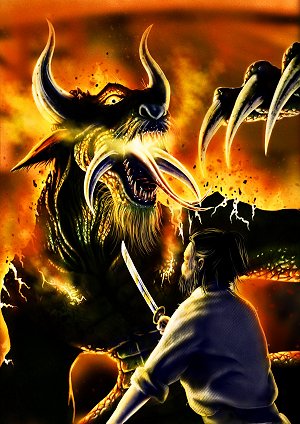
The Tale of Junko and Sayuri
by Peter Beagle
In Japan, very, very, long ago, when almost anybody you met on the road might
turn out to be a god or a demon, there was a young man named Junko. That name
can mean "genuine" in Japanese, or "pure," or "obedient," and he was all of those
things then. He served the great daimyo Lord Kuroda, lord of much of southern
Honshu, as Chief Huntsman, and was privileged to live in the lord's castle itself,
rather than in any of the outer structures, the yagura. In addition, he was handsome
and amiable, and all the ladies of the court were aware of him. But he had no
notion of this, which only added to his charm. He was a very serious young man.
He was also a commoner, born of the poorest folk in a poor village, which meant
that he had not the right even to a family name, nor even to be called Junko-san as
a mark of respect. In most courts of that time, he would never have been permitted
to look straight into the eyes of a samurai, let alone to live so intimately among
them. But the Lord Kuroda was an unusual man, with his own sense of humor, his
own ideas of what constituted a samurai, and with a doubtless lamentable tendency
to treat everyone equally. This was generally blamed on his peculiar horoscope.
Now at this time, it often seemed as though half of Japan were forever at war with
the other half. The mighty private armies of the daimyos marched and galloped up
and down the land, leaving peasant villages and great fortresses alike smoldering
behind them as they pleased. The shogun at Kyoto might well issue his edicts from
time to time, but the shogunate had not then the power that it was to seize much
later; so for the most part his threats went unheeded, and no peace treaty endured
for long. The Lord Kuroda held himself and his own people aside from war as
much as he could, believing it tedious, pointless and utterly impractical, but even
he found it wise to keep an army of retainers. And the poor in other less fortunate
prefectures replanted and built their houses again, and said among themselves that
Buddha and the kami -- the many gods of Shinto -- alike slept.
One cold winter, when game was particularly scarce, Junko went out hunting for
his master. Friends would gladly have come with him, but everyone knew that
Junko preferred to hunt alone. He was polite about it, as always, but he felt that the
other courtiers made too much noise and frightened away the winter-white deer
and rabbits and wild pigs that he was stalking. He himself moved as quietly --
even pulling a sledge behind him -- as any fish in a stream, or any bird in the air,
and he never came home empty-handed.
On this day, as Amaterasu, the sun, was drowsing down the western sky, Junko
also was starting back to the Lord Kuroda's castle. His sledge was laden with a fat
stag, and a pig as well, and Junko knew that another kill would load the sledge too
heavily for his strength. All the same, he could not resist loosing one last arrow at a
second wild pig that had broken the ice on a frozen stream, and was greedily
drinking there, ignoring everything but the water. It was too good a chance to pass
up, and Junko stood very still, took a deep breath -- then let it out, just a little bit,
as archers will do -- and let his arrow fly.
It may have been that his hands were cold, or that the pig moved slightly at the last
moment, or even that the growing twilight deceived Junko's eye, though that seems
unlikely. At all events, he missed his mark -- the arrow hissed past the pig's left
ear, sending the animal off in a panicky scramble through the brush, out of sight
and range in an instant -- but he hit something. Something at the very edge of the
water gave a small, sad cry, thrashed violently in the weeds there for a moment,
and then fell silent and still.
Junko frowned, annoyed with himself; he had been especially proud of the fact that
he never needed more than one arrow to bring down his prey. Well, whatever little
creature he had accidentally wounded, it was his duty to put it quickly out of its
pain, since an honorable man should never inflict unnecessary suffering. He went
forward carefully, his boots sinking into the wet earth.
He found it lying half-in, half-out of the stream: an otter, with his arrow still in his
flank. It was conscious, but not trying to drag itself away -- it only looked at him
out of dazed dark eyes and made no sound, not even when he knelt beside it and
drew his knife to cut its throat. It looked at him -- nothing more.
"It would be such a pity to ruin such fur with blood," he thought. "Perhaps I could
make a tippet out of it for my master's wife." He put the knife away slowly and
lifted the otter in his arms, preparing to break its neck with one swift twist. The
otter's sharp teeth could surely have taken off a finger through the heavy mittens,
but it struggled not at all, though Junko could feel the captive heart beating wildly
against him. When he closed his free hand on the creature's neck, the panting
breath, so softly desperate, made his wrist tingle strangely.
"So beautiful," he said aloud in the darkening air. He had never had any special
feeling about animals: they were good to eat or they weren't good to eat, though he
did rather admire the shimmering grace of fish and the cool stare of a fox. But the
otter, hurt and helpless between his hands, made him feel as though he were the
one wounded, somehow. "Beautiful," he whispered again, and very carefully and
slowly he began to withdraw the arrow.
When Junko arrived back at his lord's castle, it was full dark and the otter lay
under his shirt, warm against his belly. He delivered his kill, to be taken off to the
great kitchens, gravely accepted the thanks due him, and hurried away to the
meager quarters granted him at the castle as soon as it was correct to do so. There
he laid the otter on a ragged old cloak that his sister had given him when he was a
boy, and knelt beside the creature to study it in lamplight. The wound was no
worse than it had been, and no better, though the blood had stopped flowing. He
gave the otter water in a little clay dish, but it sniffed feebly at it without drinking;
when he put his hand gently on the arrow-wound, he could feel the fever already
building.
"Well," he said to the otter, "all I know to do is to treat you as I did my little
brother, the time he fell on the ploughshare. No biting, now." With his dagger, he
trimmed the oily brown fur around the injury; with a rag dipped in hot nihonshu,
which others call sake, he cleaned the area over and over; and with herbal infusions
whose use he had learned from his mother's mother, he did his best to draw the
infection. Through it all the otter never stirred or protested, but watched him
steadily as he labored to undo the damage he had caused. He sang softly now and
then, old nonsensical children's songs, hardly knowing he was doing it, and now
and then the otter cocked an ear, seeming to listen.
When he was done he offered the water again, and this time the otter drank from
the dish, cautiously, never taking its eyes from him, but deeply even so. Junko then
lifted it in the old cloak and set all upon his own tatami mat, saying, "I cannot bind
your wound properly, but healing in open air is best, anyway. And now you should
sleep." He covered the otter with his coat, then lay down near it on the tatami and
quickly fell asleep himself. The otter was awake longer than he, its wide eyes
darker than the darkness.
In the morning the gash in the otter's flank smelled far less of fever, and the little
animal was clearly hungry. Knowing that otters eat mainly fish, along with such
things as frogs and turtles, Junko dressed hurriedly and went to a river that was
near the castle (the better for the daimyo to keep an eye on the boats that went up
and down between the distant cities), and there he caught and cleaned several small
fish and brought them back to his quarters. The otter devoured them all, groomed
its fur with great care -- spending half an hour on its exposed wound alone -- and
then fell back to sleep for the rest of the day, much of which Junko spent studying
it, sitting crosslegged beside his tatami. He was completely captivated to learn that
the otter snored -- very daintily and delicately, through its diamond-shaped nose
-- and that it smelled only slightly of fish, even after its meal, and much more of
spring-warmed earth, as deep in winter as they were. He touched its front claws
and realized that they were almost as hard as armor.
When a highly-placed serving woman suggested through another servant that she
might possibly enjoy his company for tea, Junko made the most courteous apology
he could, and went on staring at the otter on his sleeping mat. Towards evening the
little creature woke up and lay considering him in its turn, out of eyes much
brighter and clearer than they had been. He spoke to it then, saying, "I am very
sorry that I hurt you. I hope you are better today." The otter licked its whiskers
without taking its eyes from his.
During the days that passed, Junko told no one about the otter: neither the Lord
Kuroda nor his wife, the Lady Hara, nor even his closest friend, the horsemaster
Akira Yamagata, who might have been expected to understand his fascination. He
fed and cared for the otter every day, cleaned and aired out his quarters himself,
and saw the arrow-wound closing steadily from the inside, as every soldier knows
is the proper way of healing. And the otter lay patiently under his hands as he
tended it, and shared his tatami at night; and if it did not purr, or arch itself back
against his hands, as a cat will, when he stroked its beautiful, rich fur, nevertheless
it never drew away from the contact, but looked constantly into his eyes, as though
it would have spoken to him if it could. He fell into the habit of talking to it
himself, more and more, and he named it Sayuri, because men have to name things,
and Sayuri was his sister's name.
One morning he told the otter, "My lord will have me guide a hunt meeting with
the Lord Sugihara, down on holiday from Osaka. I am not looking forward to it,
because neither trusts the other for an instant, and it could all become very
wearying, though certainly educational. But when I return, however late it may be,
I will take you back to your stream and release you there. You are fully recovered
now, and a castle is no place for a wild creature like yourself. Stay well and warm
until I come back."
The meeting between the two lords was indeed tiresome, and the hunt itself
extremely unsatisfactory; but it had at least the virtue of taking less time than he
would have expected, so the sun was still in the sky when Junko climbed the stair
to his quarters. He went slowly, remembering his promise to the otter, and finding
himself curiously reluctant to keep it. "It will be lonely," he thought. "I will miss
. . . what is it that I will miss?" He could not say, but he knew that it was a real
thing. So he sighed and went on to his quarters and opened the door.
The otter was gone.
In its place there stood, waiting for him, the most beautiful young woman he had
ever seen. She stood barely higher than his heart, wearing a blue and white
kimono, and her face was the dawn shade of a tea-rose, and as perfectly boned and
structured as the kites that children were competing with every spring even then.
Junko stood gaping at her, not even trying to speak.
"Yes," she said quietly, smiling with small white teeth at his bewilderment. "I am
indeed that otter you shot, and then nursed back to health so tenderly. I am quite
well now, as you see."
"But," said Junko. "But."
The young woman smiled more warmly as he stumbled among words, finding only
that one. "This is my true form, but I take other shapes from time to time, as I
choose. And it is so pleasant to be an otter -- even as they hunt and mate, and raise
their children, and struggle to survive, they seem to be having such a joyful time of
it. Don't you think so, my lord?"
Junko said, "But" again, that being the only word he was quite master of. The
woman came toward him, her long, graceful fingers toying with the knot of the obi
at her waist.
"I could not return to my own form until today," she explained to him, "because I
was wounded, which always keeps me from changing. I might very well have died
an otter, but for your devoted care. It is only proper that I make you some little
recompense, surely?"
She seemed so hesitant herself that the last words came out a shy question. But the
obi had already fallen to the floor.
Later, in the night, propped on her elbow and looking at him with eyes even darker
than the otter's eyes, she said, "You have never lain so with a woman, have you?"
Junko blushed in the darkness. "Not exactly. I mean, of course there were . . . No."
The young woman was silent for a time. Then she said, "Well, I will tell you
something, since you have been so honest with me. Nor will I lie to you -- I have
mated, made love, yes, but never in this form. Only as a deer, or a wildcat, or even
as a snow monkey, in the northern mountains. Never as a human being, until now."
"And you are human?" Junko asked her. "Forgive me, but are you sure you are not
an animal who can change into a woman?" For there are all sorts of legends in
Japan about such creatures. Especially foxes.
She chuckled against his shoulder. "I am altogether human, I promise you." After a
moment, she added, "You named me Sayuri. I like that name. I will keep it."
"But you must have a name of your own, surely? Everyone has a name."
"Not I, never." She put a finger on his lips to forestall further questioning. "Sayuri
will suit me very well."
And the beautiful young woman who had been an otter suited Junko very well
herself. He presented her formally as his fiancée to the Lord Kuroda the next day,
and then to the full court. He was awkward at it, certainly, never having been
schooled in such regions of etiquette; but all were charmed by the young woman's
grace and modesty, even so, despite the fact that she could offer nothing in the way
of family history or noble lineage. Indeed, Lord Kuroda's wife, the Lady Hara,
immediately requested her as one of her ladies-in-waiting. So all went well there,
and Junko -- still as dazed by his sudden fortune as the otter had been by his arrow
-- was proud and happy in a way that he had never known to be happy in all his
life.
He and Sayuri were married in short order by the Shinto priest Yukiyasa, the same
who had married Lord Kuroda to Lady Hara, which everyone agreed was good
luck, and were given new quarters in the castle -- modest still, but more fitting for
so singular a couple. More, his master, as a wedding gift, saw to it that Junko was
given proper hunting equipment to replace the battered bow and homemade arrows
with which he had first arrived at court. There were those present at the ceremony
who bit their lips in envy of such favor to a commoner; but Junko, in his desire that
everyone share in his joy, noticed none of this. The Lord Kuroda did.
Early on the morning after their wedding, when few were yet awake, Junko and his
bride walked in the castle garden, in the northeast corner, where the stream entered,
and which was known as the Realm of the Blue Dragon. The days were cold still,
but they walked close together and were content, saying very little. But the stream
made Junko think of the strange and nearly fatal way in which he had met his
Sayuri, and he asked her then, "Beloved, do you think you would ever be likely to
change into an otter again? For I hurt you by mischance, but there are many people
who trap otters for their fur, and I would be afraid for you."
Sayuri's laughter was like the sound of the water flowing beside them, as she
answered him. "I think not, my lord. There are more risks involved with that form
-- including marriage -- than I had bargained for." Then she turned a serious face
to her new husband, holding his arm tightly. "But I would grieve were I forbidden
to change shape ever again. It is a part of whatever I am, you must know that."
"'Whatever I am,'" Junko repeated slowly, and for a moment it seemed as though
the back of his neck was colder than it should be, even on a winter morning. "But
you assured me that you were altogether human. Those were your words."
"And I am, I am certain I am!" Sayuri stopped walking and turned him to face her.
"But what else am I? No name but the one you gave me . . . no childhood that I can
recall, except in flashes, like lightning, here and gone . . . no father or mother to
present me at my own wedding . . . far more memories of the many animals I have
been than of the woman I know I am. There must be more to me than I can see in
your eyes, or in the jeweled hand mirror that was the Lady Hara's gift. Do you
understand, husband?"
There were tears on her long black eyelashes, and though they did not fall, they
reassured Junko in a curious way, since animals cannot weep. He put his arms
around her to comfort her, saying, "Do as you will, as you need to do, my wife. I
ask only that you protect yourself from all injury, since you cannot regain your
human form then, and anything could happen to you. Will you promise me that?"
Then Sayuri laughed, and shook her head so that the teardrops flew, and she said,
"I swear that and more. You will never again share your sleeping mat with
anything furred, or with any more than two legs." And Junko joined in her
laughter, and they went on with their walk, all the way across the garden to the
southwest corner, which is still called the Realm of the White Tiger.
So they lived quite happily together for some years at the court of the daimyo Lord
Kuroda. Junko served his master with the same perfect loyalty as ever, and went on
providing more game than any other huntsman for the castle kitchens; while Sayuri
continued to be much favored by the Lady Hara, joining her in her favorite arts of
music, brush-painting, and especially ikebana, the spreading new discipline of
flower-arrangement. So skilled was she at this latter, in fact, that Lady Hara often
sought her assistance in planning the decorations for a poetry recital in her own
quarters, or even for a feast on the green summer island in the stream. Watching
the two of them pacing slowly by the water together, the fringes of the great lady's
parasol touching his otter-wife's thick and fragrant hair, Junko was so proud that it
pained him, and made it hard to breathe.
And if, now and then, he awoke in the night to find the space beside him still warm
but empty, or heard a rustle in the trees outside, or a sigh of the grass, that he was
huntsman enough to know was no bird, no doe teaching her fawn to strip bark from
Lord Kuroda's plum trees, he learned to turn over and go back to sleep, and ask no
questions in the morning. For Sayuri was most often back by dawn, or very soon
thereafter -- always in human shape, as she had promised him -- usually chilled
beyond the bone and needing to be warmed. And Junko would warm her and never
ask her to say where -- and what -- she had been.
She did not always leave the castle: mouse and bat were among her favorite forms,
and between those two she knew everything that was taking place within its walls.
More than once she shocked Junko by informing him that this or that high-ranking
retainer was slipping into dusty alcoves with this or that servant girl; he learned
before Lord Kuroda that the Lady Hara was again with child, and that he could
safely predict to the daimyo that this time it would finally be a boy. Animals know
these things. As an owl, she might glide silently over the forest at night, and tell
him if the deer had shifted their grazing grounds, as they did from time to time, or
were lying up in a new place. In fox-shape, she warned of an approaching forest
fire without ever seeing a flame; Junko roused the castle and gained great praise
and credit thereby. He wanted earnestly to explain that all honor was due to his
wife Sayuri, but this was impossible, and she seemed more than content with his
gratitude and their somewhat unlikely happiness. So they lived, and the time
passed.
One night it happened that she returned to their bed shivering, not with cold, nor
with fear -- there were several cats in the castle -- but, as he slowly realized, with
anger, which was not something he was used to from Sayuri. She might be by turns
as calm and thoughtful as a fox, as playful as an otter, as gentle as a deer, fiercely
passionate as any mink or marten, or as curious and mischievous as a red-faced
snow monkey. All these moods and humors he had come in time to understand --
but anger was a new thing entirely. He held her, and asked simply, "What is it, my
love?"
At first she would not speak, or could not; but by and by, when the trembling
passed a little, she whispered, "I was in the kitchen --" by this Junko knew that she
had been in mouse-shape -- "and the cooks were talking late over their own meal.
And one said it was a shame that you had been passed over for the lord's private
guard in favor of Yasunari Saito, since you had surely earned promotion a dozen
times over. But another cook said --" the words were choking her again -- "that it
made no difference, because you were a commoner with no surname, and that it
was miraculous that you were even in Lord Kuroda's home, let alone his retinue.
Miraculous -- after all you have done for them!" The tears of rage came then.
"Well, well," Junko said, stroking her hair, "that must have been Aoki. He has
never liked me, that one, and it wouldn't matter to him if I had a dozen surnames.
For the rest of it, things are the way they are, and that is . . . well, the way it is.
Don't cry, please, Sayuri. I am grateful for what I have, and most grateful for you.
Don't cry."
But later, when she had at last fallen asleep on his chest, he could not help
brooding -- only a little -- about the unfairness of Saito's promotion. Unfair was
not a word Junko had allowed himself even to think since he was quite small, and
still learning the way things were, but it seemed to slither in his mind, and he could
not get to grips with it, or make it go away. It was long before he slept again.
As has been said, the Lord Kuroda was a wise man, though not at all handsome,
who saw more at a single dinner than many were likely to see in a week or a
month. Riding out hunting one day, with Junko at his elbow, and the two having
drawn a little apart from their companions, he said to him briefly and directly,
"Saito is a fool, but his advancement was necessary, since I may well need his
father's two hundred and fifty samurai one day." Junko bowed his head without
answering. Lord Kuroda continued, "But it means nothing to me that you bring no
warriors with you -- nothing but your strength and your faithfulness. The next
opening in my guard you shall fill."
With that he spurred ahead, doubtless to avoid Junko's stammering thanks. Junko
was too overcome to be much of a hand at the hunt that afternoon; but while the
others teased and derided him for this, Lord Kuroda only winked gravely.
Of course Sayuri was overjoyed at the news of the lord's promise, and she and
Junko celebrated it with nihonshu and love, and then shochu, which is brewed from
rice and sweet potatoes and a few other things. And afterward it was her turn to lie
awake in the night, with her husband in her arms, and her mind perhaps full of
small-animal thoughts. And perhaps not; who knows? It was all so long ago.
But it was at most a month before the horse of the samurai Daisuke Ikeda shied at a
rabbit underfoot, reared, fell backwards and crushed his rider. There was much
sorrow at court, for Ikeda was the oldest of the daimyo's guard, and a well-liked
man; but there was also a space in the guard to fill, and Lord Kuroda was as good
as his word. Within days, Junko was wearing his master's livery, for all the world
as though he were as good as Ikeda, or anyone else, and riding at his side on a fine,
proud young stallion. And however many at court may have thought this highly
unsuitable, no one said a word about it.
Junko also grieved for Ikeda, who had been kind to him. But his delight in his new
position was muted, more than he would have expected, by his odd disquiet
concerning that rabbit. Riding in the rear, as befit a commoner (it had been a
formal procession, meant to impress a neighboring lord), he had seen the animal
shoot from its hole, seemingly as blindly as though red-eyed Death were on its
heels; and he had never known Ikeda's wise old horse to panic at an ambush, much
less a rabbit. One worrisome thought led to another, and that to a third, until finally
he brought them all to his wife. He had grown much in the habit of doing this.
Sayuri sat crosslegged on the proper new bed that the Lord Kuroda had given them
to replace their worn tatami, and she listened attentively to Junko's fears, saying
nothing until he was finished. Then she replied simply, "Husband, I was not the
rabbit -- I was the weasel just behind it, chasing it out of its burrow into the
horse's path. Can you look at your own new horse -- at your beautiful new livery
-- at this bed of ours -- and say I have done wrong?"
"But Ikeda is dead!" Junko cried in horror. "Ask rather how I can look at his
widow, at his children, at my master -- at myself in the mirror now! Oh, I wish
you had never told me this, Sayuri!"
"Then you should not have asked me," she answered him. "The weasel never
meant for the good Ikeda to be killed -- though he was old and should have retired
from the guard long ago. The weasel only wanted the rabbit." She beckoned Junko
to sit beside her, saying, "But is a wife not supposed to concern herself with the
advancement of her husband's fortunes? I was told otherwise by the priest who
married us." She put her arms around Junko. "Come, my love, take the good luck
with the regrettable, and say as many prayers for Ikeda's repose as will comfort
you." She laughed then: the joyous childlike giggle that never failed to melt even
the sternest heart. "Although I think that I am more skilled at that than any prayer."
But Junko paced the castle all night, and wandered the grounds like a spirit; and it
was dawn before he could at last reassure himself that what she had told him was
both sound and sensible. Ikeda's death had clearly been an accident, after all, and
there was nothing in the least shameful in making the best of even such a tragedy.
Sayuri's shapeshifting had brought about great good for him, however
unintentional; let him give thanks for such a wife and, as he rode proudly beside
the Lord Kuroda, bless the wandering arrow that had found an otter instead of a
wild pig. "She is my luck," he thought often. "I should have given her that name,
luck, instead of little lily."
But he did, indeed, pray often at the family shrine erected for Daisuke Ikeda.
Now, in time Junko came to realize that, while he had certainly been honored far
beyond his origins in becoming part of Lord Kuroda's private guard, he had also
attained a kind of limit beyond which he had no chance of rising. Above the guard
stood his master's counselors and ministers: some of them higher in rank than
others, some higher in a more subtle manner, unspoken and unwritten. In any case,
their world was far out of reach for a nameless commoner, no matter how
graciously favored by his lord. He would always be exactly what he was -- unlike
Sayuri, who could at least become different animals in her search for her true
nature. And, understanding this, for the first time in his life Junko began to admit
aloud that the world was unjust.
"Look at Nakamura," he would say resentfully to his wife over the teacups. "Not
only does he review the guard when Lord Kuroda is away or indisposed --
Nakamura, who barely knows a lance from a chopstick -- he advises my master on
diplomacy, when he has never been north of the Inland Sea in his life. And
Hashimoto -- Finance Minister Hashimoto, if you please -- Hashimoto holds the
position for no other reason than that he is Lady Hara's second cousin on her
father's side. It is not correct, Sayuri. It is not right."
Sayuri smiled and nodded, and made tea. She had become celebrated among the
ladies-in-waiting for the excellence and delicacy of her gyukuro green tea.
And a few weeks later, Minister Shiro Nakamura, who loved to stroll alone in the
castle gardens before dawn, to catch the first scent of the awakening flowers, was
found torn in pieces by what could only have been a wolf. There were never many
wolves in Japan, even then, but there was no question of the killer in this case: the
great paw-prints in the soft earth were so large that Junko suggested that the animal
might well have come from Hokkaido, where the wolves were notably larger. "But
how could a wolf ever find its way from Hokkaido Island so far south to Honshu?"
he asked himself in the night. "And why should it do so?" He was very much
afraid that he knew the answer.
The hunt that was immediately organized after the discovery of Minister
Nakamura's still-warm body found no wolf of any species, but it did find blood in
one of the paw prints, and on the blade of the antique dagger that Nakamura always
carried. Sayuri was not at home when Junko returned; nor did she appear for
several days, and even then she looked pale and faint, and spoke little. Junko made
the excuse of illness to the Lady Hara, who sent medicines and dainties, plainly
hoping that Sayuri's reported condition might betoken a new godchild. For his
part, he asked no questions of his wife, knowing that she would tell him the truth.
She always did.
It took more time, and a great deal of courteously muffled scandal and outrage at
court before Junko ascended into the ranks of Lord Kuroda's advisors. He did not
replace Minister Nakamura, but a station was created for him: that of Minister to
the Lower Orders. When Junko's first speechless gratitude began to be replaced by
stumbling bewilderment, Lord Kuroda explained to him, thus: "By now, my friend,
you should know that I am not one of those nobles who believe that the
commoners have no reason to exist, except that we give them the privilege of
serving us. Quite a few, in fact --" and here he named a good eight or ten of the
castle servants, ending with Junko himself -- "show evidence of excellent sense,
excellent judgment." He paused, looking straight into Junko's eyes. "And where
there is judgment, there will be opinions."
By this Junko understood that he had been chosen to be a liaison -- what some
might call a spy -- between the daimyo and all those who were not nobles, priests,
or samurai. The notion offended him deeply, but he had not attained his unusually
favored position by showing offense. He merely bowed deeply to the Lord Kuroda,
and replied that he would do his best to give satisfaction. The Lord Kuroda looked
long into his eyes without responding.
So Junko, surname or no, became the first commoner ever accepted into a world
his class had long been forbidden even to dream of entering. His and Sayuri's
quarters were changed once again for rooms that seemed to him larger than his
entire native village; they were assigned a servant of their own, and a new bed that,
as Sayuri giggled, was "like a great snowdrift. I am certain we will yet find a bear
sleeping out the winter with us." The haughtiness of Lord Kuroda's other
counselors, and the sense that their servant despised them, seemed a small price to
pay at the time.
Out of respect and gratitude to his master, Junko served him well as Minister to the
Lower Orders. He provoked no disloyal or rebellious conversations, but only
listened quietly to the talk of the stables, the kitchens, the deep storerooms and the
barracks. What he thought Lord Kuroda should know, he reported faithfully; what
seemed to him to be no one's business but the speakers' remained where he heard
it. And Lord Kuroda appreciated his discreet ability to tell the difference, and told
him so, even calling him Junko-san in private. And once -- not very long before at
all -- that would have been more than enough.
But again he had collided with an invisible barrier. Precisely because the post had
been invented especially for him, there was no precedent for promotion, nor any
obvious position for him to step into whenever it should become vacant. Those
who had always been kindly and amiable to Junko the castle's chief huntsman,
now looked with visible contempt on Junko the Minister, Junko the jumped-up pet
of the Lord Kuroda. Those below him took great pleasure in observing his
frustration and discomfort; when they dared, they murmured as they passed him,
"Did you think you were better than we are? Did you really believe they would let
you become one of them? Then you were a fool -- and now you are no one. No
one."
Junko never spoke of his unhappiness to Lord Kuroda, but he expressed it once to
his friend Akira Yamagata. The horsemaster, being a silent man, much more at
ease with beasts than people, replied shortly, "Let demons fly away with them all.
You cannot win with such folk; you cannot ever be even with them in their minds.
Serve your master, and you cannot go wrong. Any horse will tell you that."
As for Sayuri, she simply listened, and arranged fresh flowers everywhere in their
quarters, and made green gyokuro tea. When she walked with Junko in the castle
gardens, and he asked her whether she felt herself any nearer to perceiving her true
nature, she most often replied, "My husband, I know more and more what I am not
-- but as to what I am . . ." and her voice would trail away, leaving the thought
unfinished. Then she would add, quickly and softly, "But human -- that, yes. I
know I am human."
Now the most clever and ambitious of the Lord Kuroda's counselors, recently
become Minister Of Waterways and Fisheries, was a man named Mitsuo Kondo.
Perhaps because he was little older than Junko, only now approaching his middle
years, he went well out of his way to show his scorn for a commoner, though never
in the presence of the daimyo. In the same way, Junko responded humbly to
Kondo's poorly-veiled insults; while at home he confided to his wife that he often
dreamed of wringing the man's thin neck, as he had so often done with chickens in
his childhood. "Being of low birth, I am naturally acquainted with barnyards," he
remarked bitterly to Sayuri.
It happened that on a warm night of early summer, Junko woke thirsty to an empty
bed -- he was quite used to this by now -- and was still thirsty when he had drunk
the last remaining green tea. Setting off to find water, barefooted and still drowsy,
he had just turned into a corridor that led to the kitchens, when he heard the
scraping of giant claws on a weathered sugi-wood floor, and flattened himself
against the wall so hard that the imprint of the molding remained on his skin for
hours afterward.
A huge black bear was lumbering down a passageway just ahead. It must surely
have smelled his terror -- or, as he imagined, heard the frantic beating of his heart
-- for it hesitated, then rose on its hind legs, turning toward his him to sniff the air,
growling softly. He saw the deep yellow-white chevron on the creature's breast, as
well as the bright blood on its horrific fangs and claws, and he smelled both the
blood and the raw, wild, strangely sweet odor of the beast itself. Even armed he
might not be the creature's match; weaponless, he knew this was the moment of his
death. But then the bear's great bulk dropped to the floor again, turning away, and
his forgotten breath hissed between his teeth as the animal moved slowly on out of
his sight, still growling to itself.
Junko did not go back to his quarters that night, but sat shivering where he was
until dawn, tracing a trail of dead moss between two floorboards over and over
with his forefinger. Then at last he slipped warily back into the new bed where
Sayuri had laughingly imagined a bear keeping them company. She was sound
asleep, not even stirring at his return. Junko lay still himself, studying her hands:
one partly under her head, one stretched out on the pillow. There was no blood on
any of the long fingers he loved to watch moving among her flowers. This was not
as reassuring to him as it might once have been.
The hunt for Minister Kondo went on for days. The blood trail was washed away
by a sudden summer rain, except for the track leading from his private offices, and
other indications that he had been carried off by some great animal, or something
even worse. For all his dislike of Kondo, Junko took a leading part in the hunt --
as did Lord Kuroda himself -- from its earliest moments to the very last, when it
was silently agreed that the Minister's body would never be found. Lord Kuroda
commanded ten days of mourning, and had a shrine created in Minister Kondo'smemory on his own summer island. It is still there, though no one today knows
whom it was meant to honor.
Even after the proper period of remembrance had passed, the empty place among
the daimyo's counselors remained unfilled for some considerable while. Few had
liked Kondo any more than Junko did; all had feared his ambition, his gifts, and his
evil tongue, and many were happy that he was gone, however horrified they may
have been at the manner of his departure. But Lord Kuroda was clearly grieved --
and, more than that, suspicious, though of what even he could not precisely say.
Wolves and bears were common enough in Honshu in those days, but not in
Honshu gardens and palaces; nor was the loss of three important members of his
court, each under such curious circumstances, something even a mighty daimyo
could easily let pass. The tale had already spread through the entire province, from
bands of half-naked beggars huddled muttering under bridges to courts as great as
his own. There was even a delicate message from the Shogun in Kyoto. Lord
Kuroda brooded long over the proper response.
Junko came to feel his master's contemplative eyes on him even when he was not
in Lord Kuroda's presence. At length, to ease his mind, he went directly to the
daimyo and asked him, "Lord, have I done wrong? I pray you tell me if this is so."
For he knew his own silent part in the three deaths, and he was afraid for his wife
Sayuri.
But Lord Kuroda answered him gently, "Your pardon, loyal Junko, if I have caused
you to be more troubled than we all are, day on day. I think you know that I have
often considered your country astuteness to be of more plain practical aid to me
than the costly education of many a noble. Now I wonder whether you might have
any least counsel to offer me regarding the terrible days through which we are
passing." He permitted himself a very small, sad chuckle. "Because, just as
everyone in my realm knows his station, my own task is to provide each of them
with wisdom, assurance, and security. And I have none to offer them, no more than
they. Do you understand me, Junko?"
Then Junko was torn in his heart, for he had never lost his fondness for the Lord
Kuroda, and it touched him deeply to see the daimyo so distressed. But he shook
his head and murmured only, "These are indeed dark times, my lord, and there is
nothing that would honor my unworthy self more than to offer you any candle to
light your way. But in all truth, I have no guidance for you, except to offer sacrifice
and pay the priests well. Who but they can read the intentions of the kami?"
"Apparently the gods' intentions were for my priests to leave me," the Lord
Kuroda replied. "Half of them ran off when Minister Nakamura's body was
discovered, and you yourself have seen the rest vanishing day by day since
Kondo's has not been discovered. In a little while the only priest left to me will be
my old Yukiyasa." He sighed deeply, and turned from Junko, saying, "No matter,
my friend. I had no business to place my own yoke upon your shoulders. Go to
your bed and your life, and think no more of this. But know that I am grateful . . .
grateful." And as he shuffled away, disappearing from sight among his
bodyservants, it seemed to Junko for the first time that his master was an old man.
He repeated the conversation to Sayuri, generally satisfied with the way he had
responded to the daimyo's queries, but adding in some annoyance, "I expected him
to offer me Kondo's position, but he never mentioned it. It will surely come, I am
certain."
Sayuri had grown increasingly silent since the night of the black bear, more and
more keeping to their quarters, avoiding her many friends and interests, shirking
her duty to the Lady Hara when she dared; most often taking refuge in sleep, where
she twitched and whimpered as Junko had never known her to do. Now, without
looking at him, she said, "Yes. It will come."
And so it did, in good time, and with little competition, whether direct or stealthy,
for rising to high rank at the court of Lord Kuroda more and more clearly involved
risking a terrible end. There was no one who openly connected the deaths with the
steady advancement of the peasant Junko -- Junko-san now, to all, by special
order -- nor, certainly, with his charming and modest wife -- but there were some
who pondered, and one in particular who pondered deeply. This was Yukiyasa.
Yukiyasa was the Shinto priest who had married Sayuri to Junko. As the Lord
Kuroda had predicted, he was the only priest who had not fled the court, and the
only person who seemed able to rouse Sayuri from her melancholy torpor. Out of
his hearing, he was called "The Turtle," partly due to his endlessly wrinkled face
and neck, but also because of his bright black eyes that still missed nothing -- not
the smallest change in the flowing of the sea or the angle of the wind, not the
slightest trembling of the eyelashes of a woman fearing to show fear for her
husband far away in battle. If age had slowed his step, it seemed to have quickened
his perceptions: he could smell rain two days off, identify a Mongolian plover
before others could be sure it was even a bird, and hear a leaf's fall or a
fieldmouse's squeak through the castle walls. But he did look more and more like a
turtle every season.
Junko instinctively avoided the old priest as much as he could, keeping clear of the
inari shrine he maintained, except during the Shogatsu Matsuri, the New Year's
festival. But Yukiyasi visited with Sayuri almost daily -- in her quarters, if she did
not come to the shrine -- reading to her from the Kojiki and the Nihon shoki,
teasing and provoking her until she had no choice but to smile, often remarking
that she should one day consider becoming a Shinto priest herself. She always
changed the subject, but the notion made her thoughtful, all the same.
"Today he said that I understood the way of the gods," she reported to Junko one
spring evening. "What do you suppose he meant by that?"
They were walking together in the Realm of the Blue Dragon, still their favorite
part of the castle gardens, and Junko's attention was elsewhere at the moment,
contemplating the best use of the numerous Waterways and Fisheries that ran
through the Lord Kuroda's vast domain. Now, his notice returning to his wife, he
said, "The kami have always been shapeshifters; look at the foxes your friend's
shrine celebrates. Perhaps he senses . . ." He did not finish the sentence.
Sayuri's grip on his arm tightened enough to hurt him. "No," she said in a small
voice. "No, that cannot be, cannot. I change no longer. Never again" Her face had
gone paler than the moon.
"The bear?" He had never meant to ask her, and immediately wished he could take
back the question. But she answered him straightforwardly, almost in a rush, as the
melting snows had quickened the measure even of Lord Kuroda's gentle stream.
"I was so frightened to be the bear. I didn't like it at all. It was a terrible thing."
"A terrible thing that you were -- or a terrible thing you did?" He could not keep
his own words from tumbling out.
"Both," she whispered, "both." She was crying now, but she resisted strongly
when Junko tried to hold her. "No, no, you mustn't, it is too dangerous. I am sorry,
so sorry, I so wish your arrow had killed me. Then Ikeda would be alive, and
Nakamura, and Kondo --"
"And I would still be what I was born," Junko interrupted her. "Junko the hunter,
lower than any cook -- because a cook is at least an artist, while a huntsman is a
butcher -- Junko, with his peasant ways and peasant accent, barely tolerable just as
long as he keeps to his place. If it were not for you, my otter, my wolf --"
"No!" She twisted away from him, and actually ran a few paces off before she
turned to stare at him in real horror. It was long before she spoke again, and then
she said quietly, "We have quite traded places, have we not, my husband? You
were the one who grieved for the poor victims of my shape-changing, and it was I
who laughed at your foolish concern and prided myself upon the improvements I
brought to your fortunes, as a good wife should do. And now . . ." She faltered for
a little, still looking at him as though he were the strange animal she had never
seen before. "Now you turn out to be the shapeshifter, after all, and I the soft fool
who'll have none of it, no more. Not even for love of you -- and I loved you when
I was an otter -- not even for the sake of at last learning my own being, my own
soul. That can go undiscovered forever, and welcome, and I will remain Sayuri,
your wife, no more and no less. And I will tend three graves, and pray at the shrine,
and live as I can with what I have done. That is how it will be."
"'That is how it will be,'" Junko mimicked her. "And I? I am to rise no higher at
this court, where the old men despise me and the young ones plot against me -- all
because you have suddenly turned nun?" He moved toward her, his eyes
narrowing. "Yukiyasa," he said slowly. "It's the Turtle, isn't it? That horrible
antique, with his foul-smelling robes and his way of shooting his head out and
blinking at people. It's Yukiyasa who has put all this into your head, I know it. I
swear, if I really could change my shape --"
But Sayuri covered his mouth with her hand, crying, "Don't! Don't ever say that, I
beg you! You have no idea what that is like, what that is, or you would never say
such a thing." In that moment, the look in her beautiful dark eyes made Junko think
of the black bear rising on its hind legs and turning to sniff the air for him, and he
was afraid of her. He did not move, nor did he try to speak, until she took her hand
away.
Then he said, not mockingly this time, but as soothingly as he knew how, "Well,
we have come a very long way together -- too long a way for us to turn on each
other now. I ask pardon for my thoughtlessness and my stupidity, and I promise
never to speak of . . . what we will not speak of, ever again. Such advancement as I
can win on my own, that will I do, and be well satisfied with my own nature, and
my own fate. Will that content you, my wife?"
"That will content me, husband," she whispered after a little. She did not resist
when Junko put his arms around her, but he could feel the fear in her body, and so
he added lightly, "And I promise also never to say another word concerning your
Turtle, for I know how much his wisdom and kindness mean to you. Not a word --
not even if you were indeed to become a priest, as he wishes you to do. So." He
stroked her hair, as she had always liked him to do. "Shall we go on with our
walk?"
And Sayuri laughed for the first time in a long while, and she nodded and put her
arm through his, and they walked on together.
But it was not true; though, to do him justice, Junko tried earnestly, for a while, to
believe it so. Even while taking his new post as Minister of Waterways and
Fisheries with all seriousness -- descended as he was from river people who had
manned weirs, dams and sluices throughout Honshu and Shikoku for generations
-- he could not help coveting another position: that of Masanori Morioka, Chief
Minister for Dealing with Barbarians. This ranked just under the Lord Kuroda
himself -- in another country, Morioka would have been called Prime Minister --
and where the daimyo was aging visibly, Morioka was only a year or two older
than Junko himself. Far more important, he came of a high samurai family, and,
since Lord Kuroda and the Lady Hara had no children, he might already have been
chosen to succeed his lord when the time came. Junko was increasingly certain of
this: the Lord Kuroda was no one to leave his lands in chaos while his relatives
went to war over so rich a prize. It must be Morioka; there could be no doubt of it.
In the past, this would have mattered little to the Junko whose only concern was
whether the rains had brought enough new grass for the deer, and if the snow
monkeys' unusually thick coats might foretell an evil winter. But it mattered now
to this Junko, and -- again to be fair -- he did his best to conceal his jealousy from
his wife. In this he failed, because he talked in his sleep almost every night, and
Sayuri's heart shivered to decipher his mumblings and his whispered rants. She
would lie as close to him as she could then, hoping somehow to absorb his aching
resentment into her own body, and wishing once again, deeply and dearly, that she
had died an otter.
As the Lord Kuroda grew more frail, and Morioka steadily assumed a greater share
of the daimyo's responsibilities, Junko's anger and envy became more and more
plain to see, and not only by his wife. Lady Hara spoke of it with some disquiet to
Sayuri; and Akira, the taciturn horsemaster, told Junko that he needed to ride out
more, and to spend more time in the company of horses than of courtiers, and less
time fretting over childish matters that he could not control in any case. And it was
Lord Kuroda himself, having summoned Junko to him in private, who was the one
to ask, "Have I done wrong, then? What troubles you, Junko-san?" For he always
showed a tenderness toward Junko that made certain spiteful folk grumble that the
daimyo had fathered him in secret on a peasant woman.
Then Junko, for a moment, was ashamed of his bitterness, and he knelt before Lord
Kuroda and put his hands between the hard old hands that trembled only a little,
even now, and he whispered, "Never have I had anything from you but goodness
beyond my worth. But I would have enjoyed the opportunity to serve you that
others have earned -- perhaps through ability, perhaps . . . not."
By this Lord Kuroda knew that he was speaking of Masanori Morioka. He
responded with unaccustomed sternness. "Minister of Waterways and Fisheries
you are, and I would never permit even Morioka to trespass on a single one of the
duties and privileges that your honorable service has won for you. But we must
always remember that all barbarians believe themselves to be civilized, and dealing
with such people while keeping the dangerous truth from them requires a subtlety
that few possess. You are not one of them, Junko-san."
He smiled at Junko then, leaning stiffly forward to raise him to his feet. "Nor am I,
not really. It is a matter of training from one's childhood, my friend -- learning to
sense and walk, even in the dark, the elusive balance between humility and
servility, candor and courtesy, power and the appearance of power. Masanori
Morioka is far better at this game than I ever was, even when I was young. Let the
worst come, I will have no fears for my realm in his hands."
With those words, the worst had indeed come to Junko; with those words Morioka
was doomed. Yet he managed to keep his answer calm and slow, saying merely,
"In his hands? Is it so decided, Lord?"
"It is so decided," his master replied.
Junko drew himself to his full height and bowed deeply, holding his arms rigid at
his side. "Then I also must retire from the court, since Minister Morioka and I
dislike each other too greatly to work together after you are gone. While you
remain, so will I."
But the Lord Kuroda smiled then: not widely, which was not his way, but with a
certain sad warmth that was new to his kind, ugly face. He responded only, "In that
case I will stay alive just as long as it befits me to do so," and with a small flick of
his fingers gave Junko leave to withdraw.
On the way to his quarters, he briefly encountered Morioka, who bowed mockingly
to him, saying nothing until Junko had returned the bow and passed on. Then he
called after him, "And how go the mighty consultations with our daimyo?" for he
knew where Junko had been, and he had his own envy of the Lord Kuroda's
feeling for Junko.
"As well as your great battles," Junko answered him, and Morioka scowled like a
demon-mask, since he had never borne arms for Lord Kuroda or any other, and
everyone at court knew that. So they went on to their separate destinations; and
Junko, reaching home, flung himself down on the bed and wept with a terrifying
ferocity. Nor could he stop: it was as though the tears of rage that had been
building and swelling within him since his stoic childhood had finally surged out
of his control, and were very likely to flood him as the cyclones still did every year
to his family's sliver of farmland. He was all water, and all bitterness, and nothing
beyond, ever.
He continued biting the bedclothes to muffle his weeping, but Sayuri heard him
just the same, and came to him. At first she drew back in something close to fear of
such violent anguish; but in a little she sat on the edge of the bed and put her hand
timidly on his shoulder, saying, "Husband, I cannot bear to see you so. What in this
world can possibly be such an immeasurable grief to you? Speak to me, and if I
cannot help you, I will at least share your sorrow. Share it with me now, I beg
you."
And she said all else that good wives -- and good husbands, as well -- say at such
moments; and after a long while Junko lifted his head to face her. His eyes and
nose and mouth were all clotted with tears, and he looked as children look who
have been punished for no reason they can understand. But behind the tears Sayuri
saw a hot and howling anger that would have turned him to a beast then and there,
if it could have done. In a thick, shaking voice he told her what the Lord Kuroda
had told him, ending by saying, more quietly now, "You see, it was all for nothing,
after all. All of it, for nothing."
Sayuri thought at first that he was speaking of his long, difficult climb up from his
poor peasant birth to the castle luxury where they sat together on a bed whose
sheets were of Chinese silk. But Junko, his voice gone wearily flat and almost
toneless, went on. "Everything you did for me, for us -- Ikeda, Nakamura, Kondo
-- it was all wasted, they might just as well have been spared. Yes -- they might
as well have remained alive."
"Yes," Sayuri repeated dazedly. "They might have remained alive." But then she
shook off the confused stupor that his words had brought about, and she gripped
his wrists, saying, "But Junko-san, no, I never killed for your sake. I was a bear, a
wolf, a weasel after a rabbit -- I was hungry, not human. In those beast forms I did
not even know who those men were!"
"Did you not?" the fierce question came back at her. "Be honest with yourself, my
wife. Did the wolf never know for a moment that tearing out the throat of Isamu
Nakamura would benefit a certain peasant who dreamed of becoming a counselor
to a daimyo? What of the bear -- surely the bear must have known that carrying
off the previous Minister of Waterways and Fisheries would open the way --"
"No! No, it is not true!" Still holding his wrists tightly, she shook him violently.
"The animals were innocent -- I was innocent! It was coincidence, nothing more
--"
"Was it?" They stared at each other for a moment longer, before Sayuri released
Junko's wrists and he turned away, shaking his head. "It doesn't matter, it is of no
importance. Whatever was true then, you will take no more shapes, and I . . . I will
stay not one day after Lord Kuroda is gone. We will retire to my home village, and
I will be a big man there, and you the most beautiful and accomplished woman.
And why not? -- we deserve it. And they will give us the very grandest house they
possess, in my honor, and it will be smaller than this one room, and smell of old
men. And why not? We have served the great daimyo faithfully and well, and we
deserve it all."
And saying this, he walked away, leaving Sayuri alone to bite her knuckles and
make small sounds without tears.
The old priest Yukiyasa found her so when he came to read to her, since she had
not appeared at the shrine. Having performed her wedding, he regarded her
therefore as his daughter and his responsibility, and he lifted her face and looked
long at her, asking no questions. Not did she speak, but placed one hand over his
dry, withered hand and they stood in silence, until her mind was a little eased. Then
she said, in a voice that sounded as ancient as his, "I have done evil, and may do so
again. Can you help me, Turtle?" For he knew perfectly well what he was called,
but she was the only one permitted to address him by that name.
Yukiyasa said, "Often and often does evil result where nothing but good was
meant. I am sure this is true in your case."
But Sayuri answered, "What I intended -- even if it was not quite I who intended it
-- is of no importance. What I did is what matters."
The priest peered at her, puzzled as he had not been in a very long time, and yet
with a curious sense that he might do best to remain so. He continued. "I have
many times thought that in this world far more harm is wrought by foolish men
than by wicked ones. Perhaps you were foolish, my daughter. Are you also vain
enough to imagine yourself the only one?"
That won him a fragment of a smile, coming and going so swiftly that it might
have been an illusion, and perhaps was. But Yukiyasa was encouraged, and he said
further, "You were foolish, then," not making a question of it. "Well, so. I myself
have done such things as I would never confess to you -- not because they were
evil, but because they were so stupid --"
Sayuri said, "I change into animals. People have died."
Yukiyasa did not speak for a long time, but he never took his eyes from Sayuri's
eyes. Finally he said quietly, "Yes, I see them," and he did not say whether he
meant wolves or bears, or Daisuke Ikeda, Minister Shiro Nakamura or Minister
Mitsuo Kondo. He said, "The kami did this to you before you were born. It is your
fate, but it is not your fault."
"But what I did is my fault!" she cried. "Death is death, killing is killing!" She
paused to catch her breath and compose herself, and then went on in a lower tone.
"My husband thinks that I killed those men to remove them from his path to power
in the court. I say no, no, it was the animals, not me -- but what if it is true? What
if that is exactly what happened? What should I do then, Turtle, please tell me?
Turtle, please!"
The old man took her hands between his own. "Even if every word is true, you are
still blameless. Listen to me now. I have studied the way of the kami all my life,
and I am no longer sure that there is even such a thing as blame, such a thing as
sin. You did what you did, and you are being punished for it now, as we two stand
here. The kami are never punished. This is the one thing I know, daughter, with all
my years and all my learning. The kami are never punished, and we always are."
Then he kissed Sayuri on the forehead, and made her lie down, and recited to her
from the Kojiki until she fell asleep, and he went away.
Passing the courtyard where the daimyo's soldiers trained, he noticed Junko
watching an exercise, but plainly not seeing it. The old priest paused beside him for
a time, observing Junko's silent discomfort in his presence without enjoying it.
When Junko finally bowed and started away -- still without speaking,
discourteous as that was -- Yukiyasa addressed him, saying, "I will give you my
advice, though you do not want it. Whether for a good reason or a bad one, it
would be a terrible mistake for you ever again to order your wife, in words or in
your thoughts, to become so much as a squirrel or a sparrow. A good reason or a
bad one. Do you understand me?"
Then Junko turned and strode back to him, his face white, but his eyes wide with
anger, and his voice a low hiss. "I do not understand you. I do not know what you
are talking about. My wife is no shapeshifter, but if she were, I would never make
such a request of her. Never, I have sworn to her that I would never --"
He halted, realizing what he had said. Yukiyasa looked at him for a long moment
before he repeated, "In words or in thoughts," and walked slowly on to the shrine
where he lived. Junko stared after him, but did not follow.
But by this time he was too far lost in envy of Masanori Morioka to give more than
the briefest consideration to the Shinto priest's warning. True to his promise to her,
he held himself back from urging Sayuri to remember, in so many words, that there
was no future for them in a court commanded by Morioka. Even so, he found one
way or another to put it into her mind every day; and every night he awoke well
before dawn, hoping to find her gone, as had happened so many times in their life
together. But she continued to slumber the night through, though often enough she
wakened him with her twitching and moaning, which once would have moved him
instantly to soothe and comfort her. Now he only turned over with a disappointed
grunt and drowsed off again. He had always had the gift of sleep.
Finally, on a night of early autumn, his desire was granted. The moon was high and
small, leaves were stirring softly in a warm breeze, and the space beside him was
empty. Junko smiled in the darkness and rose quickly to follow. Then he hesitated,
partly from fear of just what he might overtake; partly because it would clearly be
better to be aroused by running feet in the corridors and the dreadful news about
Minister Morioka. But it was impossible for even him to close his eyes now, so he
donned a kimono and paced their quarters from one end to the other, impatiently
pushing fragile screens aside, cursing when he tripped over pairs of Sayuri's geta,
and listening for screams.
But there was no sound beyond the soft creaking of the night, and finally the
silence became more than he could endure. Telling himself that Sayuri, in whatever
form, would surely know him, he drew a long breath and stepped out into the
corridor.
Standing motionless as his eyes grew accustomed to the darkness, he saw and
heard nothing, but he smelled . . . or almost smelled . . . no, he had no words for
what he smelled. The wild odor of the bloody-mouthed black bear was lodged in
his throat yet, as was the scent of the wolf fur clutched in the dead fingers of
Minister Nakamura. But this was a cold smell, like that of a great serpent, and there
was another underneath, even colder -- burned bone, Junko thought, though that
made no sense at all; and then, even more absurdly, bone flames. He turned to look
back at the entrance to his quarters, but it seemed already far away, receding as he
watched, like a sail on the sea.
There was no choice but to go on. He wished that he had brought a sword or a
tanto dagger, but only samurai were permitted to carry such weapons; and for all
his kindly respect and affection, the Lord Kuroda had never made any exception
for Junko. When he was in Morioka's place, he would change that. He moved
ahead, step by step, cautiously feeling his way between splashes of moonlight.
Masanori Morioka's quarters were located a floor above his own -- closer to the
daimyo's, which was something else to brood about, and tend to later. He started
up the stair, anxious neither to alert nor alarm anyone, and beginning to wonder --
all was still so quiet -- whether he had misread Sayuri's absence. What if she had
merely gone scurrying in mouse-shape, as she had once been fond of doing,
skittering in the castle rafters as a bat, or even roving outside as any sort of small
night thing? How would it look if he were surprised wandering himself where he
had no reason to be at such an hour? He paused, very nearly of a mind to turn back
. . . and yet the serpent-smell had grown stronger with each step, and so near now
that he felt as though he were the creature exuding it: as though the coldly burning
bones were, in some way, his own.
Another step, and another after, moving sideways now without realizing that he
was doing so, the serpent-smell pressing on him like a smothering blanket, making
his breath come shorter and shallower. Once he lurched to one knee, twice into the
wall, unsure now of whether he was stumbling upstairs or down . . . then he did
hear the scream.
It was a woman's scream, not a man's. And it came, not from Minister Morioka's
quarters, but from those of the Lord Kuroda and the Lady Hara.
For an instant, Junko was too stupefied to be afraid; it was as though the strings of
his mind had been cut, as well as those of his petrified body. Then he uttered a
wordless cry that he himself never heard, and sprang toward the daimyo's rooms,
kicking off his slippers when they skidded on the polished floors.
Lady Hara screamed again, as Junko burst through the rice-paper door, stumbling
over the wreckage of shattered tansu chests and shoji screens. He could not see her
or Lord Kuroda at first: the vast figure in his path seemed to draw all light and
shape and color into itself, so that nothing was real except the towering horns, the
cloven hooves, the sullen gleam of the reptilian scales from the waist down, the
unbearable stench of simmering bone . . .
"Ushi-oni!" He heard it in his mind as an insect whisper. Lord Kuroda was
standing between his wife and the demon, legs braced in a fighting stance,
wakizashi sword trembling in his old hand. The ushi-oni roared like a landslide and
knocked the sword across the room. Lord Kuroda drew his one remaining weapon,
the tanto he carried always in his belt. The ushi-oni made a different sound that
might have been laughter. The dagger fell to the floor.
Junko said, "Sayuri."
The great thing turned at his voice, as the black bear had done, and he saw the
nightmare cow-face, and the rows of filthy fangs crowding the slack, drooling lips.
And -- as he had seen it in the red eyes of the bear -- the unmistakable
recognition.
"My wife," Junko said. "Come away."
The ushi-oni roared again, but did not move, neither toward him, nor toward Lord
Kuroda and Lady Hara. Junko said, "Come. I never meant this. I never meant this."
Out of the corner of his eye, Junko saw the daimyo moving to recover his fallen
dagger. But the ushi-oni's attention was all on Junko, the mad yellow-white eyes
had darkened to a dirty amber, and the claws on its many-fingered hands had all
withdrawn slightly. Junko faced it boldly, all unarmed as he was, saying again,
"Come away, Sayuri. We do not belong here, you and I."
He knew that if he turned his head he would see a blinking, quaking Minister
Morioka behind him in the ruined doorway, but for that he cared nothing now. He
took a few steps toward the ushi-oni, halting when it growled stinking fire and
backed away. Junko did not speak further, but only reached out with his eyes. We
know each other.
He was never to learn whether the monster that had been -- that was -- his wife
would have come to him, nor what would have been the result if it had. Lady Hara,
suddenly reaching the limit of her body's courage, uttered a tiny sigh, like a child
falling asleep, and collapsed to the floor. The ushi-oni began to turn toward her,
and at that moment the Lord Kuroda lunged forward and struck with all the
strength in his old arm. The tanto buried itself to the coral-ornamented hilt in the
right side of the demon.
The ushi-oni's howl shook the room and seemed to split Junko's head, bringing
blood even from his eyes, as well as from his ears and nose. A great scaled paw
smashed him down as the creature roared and reeled in its death agony, trampling
everything it had not already smashed to splinters, dragging ancient scrolls and
brush paintings down from the walls, crushing the Lord Kuroda family shrine
underfoot. The ushi-oni bellowed unceasingly, the sound slamming from wall back
to broken wall, and everyone hearing it bellowed with the same pain, bleeding like
Junko and like him holding, not their heads and faces, but their hearts. When the
demon fell, and was silent, the sound continued on forever.
But even forever ends, and there came a time when Junko pulled himself to his
feet, and found himself face to face with Minister Morioka, pale as a grubworm,
gabbling like an infant, walking as though he had just learned how. Others were in
the room now, all shouting, all brandishing weapons, all keeping their distance
from the great, still thing on the floor. He saw the Lord Kuroda, far away across
the ruins, bending over Lady Hara, carefully and tenderly lifting her to her feet
while staring strangely at Junko. Whatever his face, as bloody as Junko's own,
revealed, it was neither anger nor outrage, but Junko looked away anyway.
The ushi-oni had not moved since its fall, but its eyes were open, unblinking,
darkening. Junko kneeled beside it without speaking. The fanged cow-lips twitched
slightly, and a stone whisper reached his ear and no other, shaping two words. "My
nature . . ." There were no more words, and no sound in the room.
Junko said, "She was my wife."
No one answered him, not until the Lord Kuroda said, "No." Junko realized then
that the expression in his master's eyes was one of deepest pity. Lord Kuroda said,
"It is not possible. An ushi-oni may take on another shape if it wishes, being a
demon, but in death it returns to its true being, always. You see that this has not
occurred here."
"No," Junko answered him, "because this was Sayuri's natural form. This is what
she was, but she did not know it, no more than I. I swear that she did not know."
He rose, biting his lower lip hard enough to bring more blood to his mouth, and
faced the daimyo directly. He said, "This was my doing. All of it. The weasel, the
wolf, the bear -- she meant only to help me, and I . . . I did not want to know." He
looked around at the shattered room filled with solemn people in nightrobes and
armor. "Do you understand? Any of you?"
The Lord Kuroda's compassionate manner had taken on a shade of puzzlement; but
the Lady Hara was nodding her elegant old head. Behind Junko, Minister Morioka
had at last found language, though his stammering voice retained none of its
normal arrogance. He asked timidly, "How could an ushi-oni not know what it
was? How could such a monster ever marry a human being?"
"Perhaps because she fell in love," the Lady Hara said quietly. "Love makes one
forget many things."
"I cannot speak for my wife," Junko replied. "For myself, there are certain things I
will remember while I live, which I beg will not be long." He turned his eyes to
Minister Morioka. "I wanted her to kill you. I never said it in those words -- never
-- but I made very sure she knew that I wanted you out of my way, as she had
removed three others. I ask your pardon, and offer my head. There can be no other
atonement."
Then the Minister shrank back without replying, for while he had no objection to
the death penalty, he greatly preferred to see it administered by someone else. But
the Lord Kuroda asked in wonder, "Yet the ushi-oni came here, to these rooms, not
to Minister Morioka's quarters. Why should she -- it -- have done so?"
Junko shook his head. "That I cannot say. I know only that I am done with
everything." He walked slowly to retrieve the daimyo's sword, brought it to him,
and knelt again, baring his neck without another word..
Lord Kuroda did not move or speak for a long time. The Lady Hara put her hand
on his arm, but he did not look at her. At last he set the wakizashi back in its
lacquered sheath, the soft click the only sound in the ravaged room, which seemed
to have turned very cold since the fall of the ushi-oni. He touched Junko's
shoulder, beckoning him to rise.
"Go in peace," he said without expression, "if there is any for you. No harm will
come to you, since it will be known that you are still under the protection of the
Lord Kuroda. Farewell . . . Junko-san."
A moment longer they stared into one another's eyes; then Junko bowed to his
master and his master's lady, turned like a soldier, and walked away, past smashed
and shivered tengu furniture, past Minister Morioka -- who would not look at him
-- through the crowd of gaping, muttering retainers, and so out of the Lord
Kuroda's castle. He did not return to his quarters for any belongings, but went
away barefoot, clad only in his kimono, and he looked back only once, when he
smelled the smoke and knew that the servants were already burning the body of the
ushi-oni that was also his wife Sayuri. Then he went on.
And no one ever would have known what became of him, if the old priest
Yukiyasa had not been the patient, inquisitive man that he was. Some years after
the disappearance of Minister Junko, the commoner who had ridden at the right
hand of a daimyo for a little while, Yukiyasa left his Shinto shrine in the care of a
disciple, picked up his staff and his begging bowl, and set off on a trail long since
grown cold. But it was not the first such trail that he had followed in his life, and
he possessed the curious patience of the very old, that is perhaps the closest mortal
approach to immortality. The journey was a trying one, but many peasant families
were happy to please the gods by offering him lodging, and peasants have long
memories. It took the priest less time than one might have expected to track Junko
to a village that barely merited the title, on a brook that was called a river by the
people living there. For that matter, Junko himself was not known in the village by
his rightful name, but as Toru, which is wayfarer. Yukiyasa found him at the brook
in the late afternoon, lying flat on his belly, fishing for salmon by the oldest
method there is, which is tickling them slowly and gently, until they fall asleep,
and then scooping them into a net. There were already six fish on the grass beside
him.
Junko was coaxing a seventh salmon to the bank, and did not look up or speak
when the old priest's shadow fell over him. Not until he had landed the last fish did
he say, "I knew it was you, Turtle. I could always smell you as far as the summer
island."
Yukiyasa took no offense at this, but only chuckled as he sat down. "The incense
does cling. Others have mentioned it."
Neither spoke for some time, but each sat considering the other. To the priest's
eye, Junko looked brown and healthy enough, but notably older than he should
have. His face was thinner, his hair had turned completely white, and there was an
air about him, not so much of loneliness as of solitude, as though what lived inside
him had left no room for another living being, or even a living thought. He chose a
good name, Yukiyasa thought. "You do well here, my son?"
"As well as I may." Junko shrugged. "I hunt and fish for the folk here, and mend
their poor flimsy dams and weirs, as I was raised to do. And they in turn shelter
me, and call me Wayfarer, and ask no questions. I am where I belong."
To this Yukiyasa knew not what to say, and the two were silent again, until Junko
asked finally, "Akira Yamagata, the horsemaster -- he is well?"
"Gone these two years and more," the priest replied gently, for he knew of the
friendship. Junko inquired after a few other members of Lord Kuroda's household,
but not once about the daimyo himself, or about Lady Hara. Wondering on this,
and thinking to provoke Junko beyond prudence, Yukiyasa began to speak of the
successes of Masanori Morioka. "Since you . . . since you left, the ascent in his
fortunes has been astonishing. He is very nearly a Council of Ministers in himself
now -- and the lord being old, and without children . . ." He shrugged, leaving the
sentence deliberately unfinished.
"Well, well," Junko said mildly, almost to himself. "Well, well." He smiled then,
for the first time at the puzzled priest, and it was a smile of such piercing
amusement as even Yukiyasa had never seen in all his long life. "I am pleased for
him, and wish him all success. Let him know of it."
"This after you sent an ushi-oni to destroy him?" It was not Yukiyasa's custom
ever to raise his voice, but perplexity was bringing him close to it. "You said
yourself that you wished Minister Morioka dead and out of your way. Sayuri died
of that envy." Startled and frightened by the anger in his words, he repeated them
nevertheless, realizing that he had loved the woman who was no woman. "She died
because you were insanely, cruelly jealous of that man you praise now."
Junko's smile vanished, replaced, not by anger of his own, but by the same weary
knowledge that had aged his face. "Not so, though I wish it were. You have no idea
how I wish that were true." He was silent for a time, looking away as he began to
gather the seven salmon into a rush-lined basket. Then he said, still not meeting the
priest's eyes, "No. My wife died because she understood me."
"What nonsense is this?" Yukiyasa cried out. He was deeply ashamed of his loss of
control, yet for once refused to restrain himself. "I warned you, I warned you, in so
many words, never again to coax her to change form -- never to let her do it, for
your sake and her own -- and see what came of your disregard! She yielded once
more to your desire, set forth to murder Minister Morioka, as she had slain others,
and thereby rediscovered the terrible truth she had forgotten for love of you. For
love of you!" The old priest was on his feet now, trembling and sweating, jabbing
his finger at Junko's expressionless face. "Understand you? How could she
understand such a man? She only loved, and she died of it, and it need not have
happened so. It need not have happened!"
The sky was going around in great, slow circles, and Yukiyasa thought that it
would be sensible to sit down, but he could not find his feet. Someone was saying
somewhere, a long way off, "She loved me when she was an otter." Then Junko
had him by the shoulders, and was guiding him carefully through the long journey
back to the grass and the ground. In time the sky stopped spinning, and Yukiyasa
drank cold brook water from Junko's cupped hands and said, "Thank you. I am
sorry."
"No need," Junko replied. "You have the right of it as much as anyone ever will.
But Sayuri knew something that no one else knew, not even I myself." He paused,
waiting until the priest's color had returned and his heartbeat had ceased to shake
his body so violently. Then he said, "Sayuri knew that in my soul, in the darkest
corner of my soul, I wished her to go exactly where she did go. And it was not to
Minister Morioka's quarters."
It took the priest Yuriyasa no time at all, dazed as he still was, to comprehend what
he had been told, but a very long while indeed to find a response. At last he said,
almost whispering, "The Lord Kuroda loved you. Like a son."
Junko nodded without answering. Yukiyasa asked him hesitantly, "Did you
imagine that if Sayuri . . . if Lord Kuroda were gone, you might somehow become
daimyo yourself?"
"'Like a son' is not like being a son," Junko replied. "No, I had no such
expectations. My master, in his generosity, had raised me higher than I could
possibly have conceived or deserved, being who I am -- what I am. In a hundred
lifetimes, how should I ever hold any grievance against the Lord Kuroda?"
Twilight had arrived as they spoke together, and fires were being lighted in the
nearest huts. Junko stood up, slinging the fish basket over his shoulder. Looking
down at Yukiyasa, his face appearing younger with the eyes in shadow, he said,
"But Sayuri knew the ushi-oni in me, the thing that hated having been shown all
that I could not have or be, and that wished, in the midst of luxury, to have been
left where I belonged -- in a place just like this one, where not one person knows
how to write the words daimyo or shogun, and samurai is a word that comes
raiding and killing, trampling our crops, burning our homes. Do you hear what I
am telling you, priest of the kami? Do you hear?"
He pulled Yukiyasa to his feet, briefly holding the old man close as a lover, though
he did not seem to notice it. He said, very quietly, "I loved Lord Kuroda for the
man he was. But from the day I entered his castle -- a ragged, ignorant boy from a
ragged village of which he was ignorant -- I hated him for what he was. I spent
days and years forgetting that I hated him and all his kind, every moment denying
it in my heart, in my mind, in my bones." For a moment he put his hand hard over
his mouth, as though to stop the words from coming out, but they came anyway.
"Sayuri . . . Sayuri knew my soul."
A child's voice called from the village, the sound sweetly shrill on the evening air.
Junko smiled. "I promised her family fish tonight. We must go."
He took Yukiyasa's elbow respectfully, and they walked slowly away from the
river in the fading light. Junko asked, "You will rest here for a few days? It is a
long road home. I know."
The priest nodded agreement. "You will not return with me." It was not a question,
but he added, "Lord Kuroda has not long, and he has missed you."
"And I him. Tell him I will forget my own name before I forget his kindness." A
sudden whisper of a laugh. "Though I am Toru now, and no one will ever call me
Junko again, I think."
"Junko-san," Yukiyasa corrected him. "Even now, he always asks after Junko-san."
Neither spoke again until they had entered the village, and muddy children were
clinging to Junko's legs, dragging him toward a hut further on. Then the priest said
quietly, "She really believed she was human. She might never have known." Junko
bowed his head. "Did you believe it yourself, truly? I have wondered."
The answer was almost drowned out by the children's yelps of happiness and
hunger. "As much as I ever believed I was Junko-san."